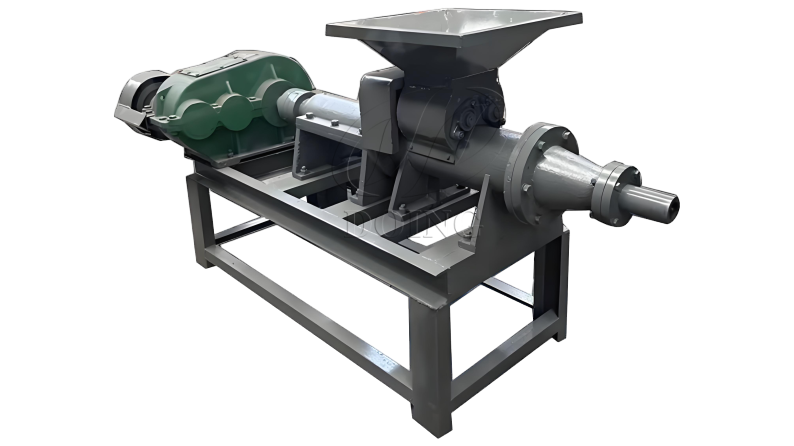

On September 4, 2026, DOING ECO (Henan DOING) signed a contract with a returning customer in Ukraine for one DY-10 charcoal making machine, designed to process 10 tonnes of furniture waste per day. The equipment will serve an end user in the furniture manufacturing industry, turning wood scraps and offcuts into marketable charcoal.
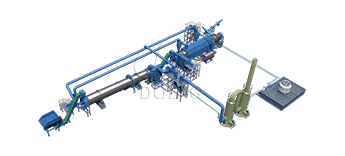
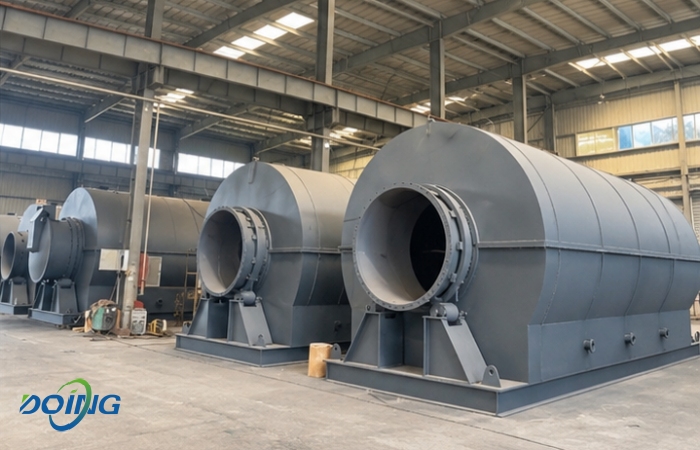 DOING DY-10 charcoal making machine
| Item | Details |
|---|---|
| Signing Date | September 4, 2026 |
| Customer Country | Ukraine |
| Equipment Model | DY-10 Batch Carbonization Furnace |
| Raw Material | Furniture waste (wood scraps, offcuts, sawdust) |
| Daily Capacity | 10 tons/day (10 T/D) |
| Monthly Capacity | Approx. 250 tonnes |
| Annual Capacity | Approx. 3,000 tonnes |
| Customer Type | Trading intermediary; end user is a furniture factory |
| Application | Charcoal production |
Monthly capacity is calculated on a 25-day basis and annual capacity on a 300-day basis. Actual throughput depends on operating days and raw material conditions.
This is not DOING ECO's first cooperation with this Ukrainian partner. Having worked with us before, the customer came back with a clear reason: they trust our integrity and professionalism. As an intermediary sourcing equipment on behalf of industrial end users, they need a supplier who quotes transparently, delivers what was agreed, and stays reachable after the machine leaves the factory. Referring to the new order, the customer noted simply that working with DOING ECO gives them confidence when they present a solution to their own clients.
The end user behind this project is a furniture manufacturer with a steady, year-round supply of production waste — board trimmings, edge offcuts and sawdust. Rather than paying for disposal, they decided to convert that waste stream into a new revenue line.
Furniture production generates a large and continuous volume of wood residue, and managing it is rarely simple:
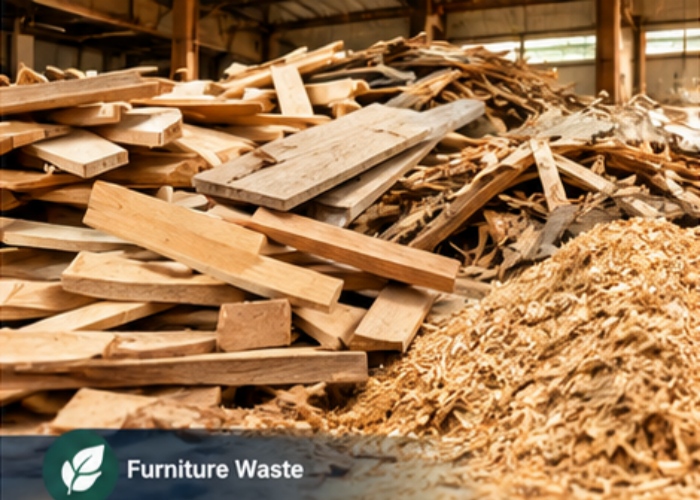 Furniture wood waste
Space and cost — waste piles up on site, occupying storage area and requiring regular, paid removal.
Inconsistent material — scraps arrive in mixed sizes and moisture levels, which challenges equipment with narrow input tolerances.
Environmental pressure — open burning or landfill disposal is increasingly restricted, and local regulations demand controlled emissions.
Operational reality — the end user wanted a solution their existing workers could run, without a steep learning curve or a large upfront investment.
The DY-10 charcoal making machine is a batch-type carbonization furnace rated at 10 tonnes per day of raw material input from a single unit. Furniture waste is loaded into the retort, carbonized under controlled temperature, then cooled and discharged — a repeatable batch cycle that consumes 10 tonnes of waste a day, around 250 tonnes per month and 3,000 tonnes per year.
Key advantages for this project:
| Feature | Benefit for the Customer |
|---|---|
| Lower capital requirement | Smaller upfront investment than a continuous production line — ideal for a first carbonization project |
| Simple operation | Existing factory staff can be trained quickly; low maintenance demand |
| Batch flexibility | Handles mixed furniture waste — trimmings, offcuts and sawdust |
| Precise temperature control | Consistent charcoal quality with high fixed carbon content |
| Flue gas treatment | Integrated gas purification and combustible gas recovery for compliant emissions |
The resulting charcoal is suitable for BBQ charcoal, shisha charcoal and industrial fuel applications, giving the end user flexible options in local and European markets.
For an intermediary, the supplier's reliability is the product. Throughout this project, DOING ECO worked directly with the customer to match the DY-10 charcoal making machine configuration to the actual waste profile — reviewing material samples, confirming drawings, and arranging a factory inspection before the contract was signed. Quotations were itemized and transparent, with no hidden add-ons.
After shipment, support continues with layout guidance, installation supervision, operator training and long-term spare parts supply — the same service standard that brought this customer back for a second order.
Ukraine's woodworking and furniture sector produces significant volumes of residue, much of which is still underused. Carbonization offers a practical upgrade path: the process reduces waste volume, eliminates disposal costs, and produces a storable, transportable fuel commodity.
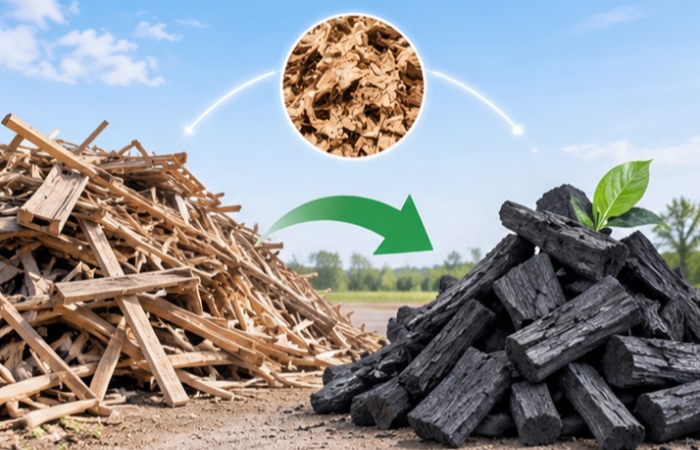 Furniture wood waste carbonization
Demand from European buyers for consistent charcoal — particularly BBQ and shisha grades — remains firm, and manufacturers able to secure reliable feedstock are well positioned. For furniture factories, this means waste handling shifts from a cost centre to a value stream.
The signing of this 10 T/D Charcoal Making Machine order on September 4, 2026 reflects two things: a repeat customer's confidence in DOING ECO, and a practical answer to a common industrial problem — what to do with furniture waste. If you have furniture waste, wood scraps or other biomass to process, contact DOING ECO for a tailored carbonization solution and a free capacity assessment.
Charcoal produced from clean furniture waste — untreated wood scraps and offcuts — is typically used as BBQ charcoal, shisha charcoal, or industrial fuel. Material quality and carbonization temperature determine the final grade and market.
Batch furnaces like the DY-10 charcoal making machine suit moderate capacities (around 10 T/D), mixed or variable feedstock, and projects with tighter initial budgets. Continuous lines are better for large, uniform volumes and steady 24-hour operation. DOING ECO helps customers compare both options against their feedstock and output targets.
Yes. Support includes foundation and layout guidance, installation supervision, operator training, and long-term spare parts supply, so the furnace stays productive over its service life.

Please provide us with project information as much as possible.



Copyright © 2015-2026 Doing Holdings - Henan Doing Environmental Protection Technology Co., Ltd | Privacy Policy | All Rights Reserved