
Palm kernel shells (PKS), a byproduct of palm oil processing, can be converted into biochar through pyrolysis. To set up a commercial palm kernel shell biochar production line, you need to consider more than the carbonization machine. Feedstock preparation, moisture control, feeding, carbonization, cooling, and gas recovery must all work together.
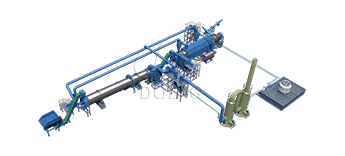
A complete PKS biochar production line generally includes eight stages: reception and storage, screening, crushing, drying, feeding, carbonization, sealed cooling, and gas recovery with exhaust treatment. The right equipment configuration depends on the raw material, required processing capacity, operating schedule, and intended biochar application.
Before selecting palm kernel shell carbonization equipment, check the raw material's moisture content, particle size, impurities, and daily availability. These factors determine which pretreatment systems are needed and how much material the production line can handle.
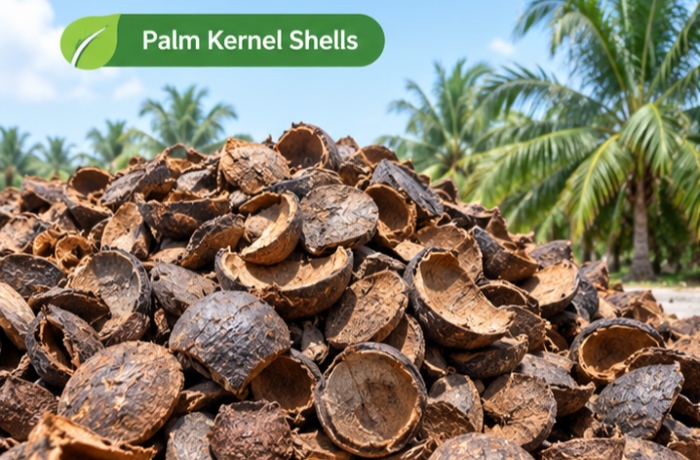 Palm kernel shells carbonization raw materials
For the continuous carbonization process, PKS should generally be crushed to 2–3 cm or smaller and dried to a moisture content of 15% or below, ideally around 10%. Excess moisture increases drying energy consumption and can reduce actual processing capacity. Sand, stones, fibers, and metal contaminants should also be removed to protect downstream equipment.
You should also define your daily PKS supply, planned operating hours, biochar application, and required product characteristics. This information provides the basis for equipment selection and capacity planning.
The complete palm kernel shell biochar production process follows this sequence:
1. Reception and Storage: Store PKS under a covered, well-drained area to prevent rainwater and ground moisture from increasing its moisture content before processing.
2. Screening: Remove sand, stones, fibers, and other unwanted materials. A magnetic separator can remove ferrous metal to protect the feeding system and reduce contamination.
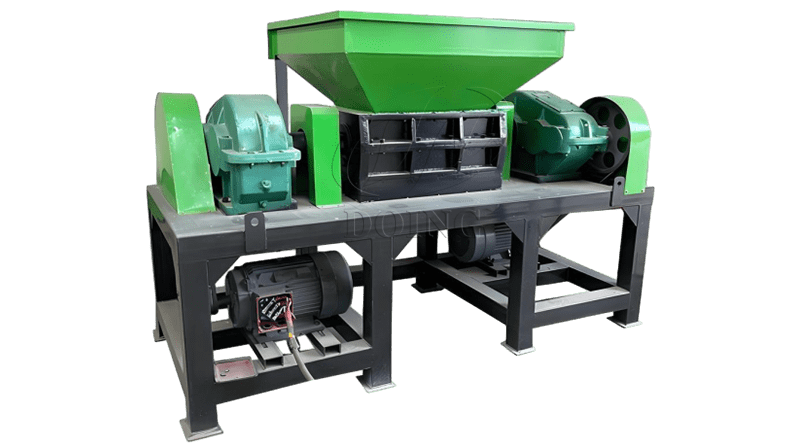
3. Crushing: Reduce oversized shells to approximately 2–3 cm or smaller. More uniform particle sizes help heat penetrate the material evenly and reduce the risk of incompletely carbonized cores.
4. Drying: Reduce feedstock moisture to 15% or below, preferably around 10%. Wet feedstock increases the drying load and can become a bottleneck that limits the production line's actual throughput.
5. Controlled Feeding: A controlled feeding system transfers the prepared PKS into the carbonization machine at a steady, adjustable rate. Consistent feeding helps match the raw material supply with the machine's processing capacity and supports stable, continuous operation.
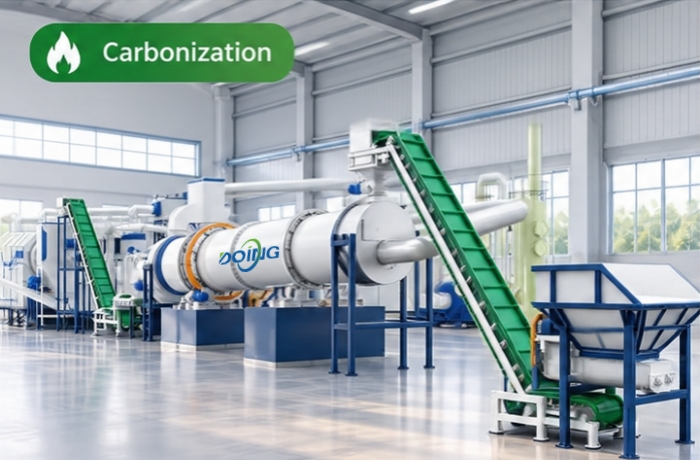 Palm kernel shell biochar making process
6. Carbonization: Convert the prepared PKS into biochar through oxygen-limited pyrolysis. Temperature and residence time should be adjusted according to the feedstock and desired biochar properties.
7. Sealed Cooling and Discharge: Cool hot biochar before exposing it to ambient air. After carbonization, hot biochar is transferred to a water-cooled char cooler to reduce its temperature to approximately 40°C before discharge and collection.
8. Gas Recovery and Exhaust Treatment: Recover suitable combustible gas for reuse in the carbonization furnace or dryer. Dust removal, scrubbing, and additional exhaust treatment or combustion should be configured according to gas composition and local environmental requirements.
The equipment required depends on the condition of the palm kernel shells (PKS), especially their particle size and moisture content. A typical production line includes the following equipment:
| Processing Stage | Main Equipment | Main Function |
|---|---|---|
| Raw Material Storage | Covered Storage Area | Stores PKS in dry conditions |
| Screening | Screening Equipment | Removes sand, stones, fibers, and impurities |
| Size Reduction | Biomass Crusher (if needed) | Reduces PKS to 2–3 cm or less |
| Drying | Rotary Dryer (if needed) | Reduces moisture to ≤15%, ideally around 10% |
| Feeding | Controlled Feeding System | Ensures steady and adjustable feeding |
| Carbonization | Carbonization Furnace, Hot-Air Furnace and Temperature Control System | Converts PKS into biochar under oxygen-limited conditions |
| Cooling and Discharge | Water-Cooled Char Cooler | Cools biochar to approximately 40°C |
| Combustible Gas Recovery | Cyclone Dust Collector and Gravity Settling Unit | Removes dust from combustible gas for reuse |
| Exhaust Treatment | Flue-Gas Treatment System | Treats exhaust gas before discharge |
The main equipment can be integrated with a PLC control system to coordinate feeding, heating, and overall production. The shredder and rotary dryer are selected according to the actual size and moisture content of the PKS.
The required capacity of a palm kernel shell biochar production line depends mainly on the daily raw material supply and planned operating hours. For example, if a project needs to process 10 tons of PKS per day and operates for 10 hours, the required processing capacity is approximately 1 ton per hour (1 T/H).
For preliminary planning, a general biomass biochar yield of around 30–35% can be used as a reference. However, the actual yield from PKS should be confirmed through feedstock testing and trial carbonization. Actual output depends on feedstock moisture, composition, and carbonization conditions. The processing capacity of the dryer, feeding system, and cooling equipment should also match the carbonization machine to avoid limiting overall production.
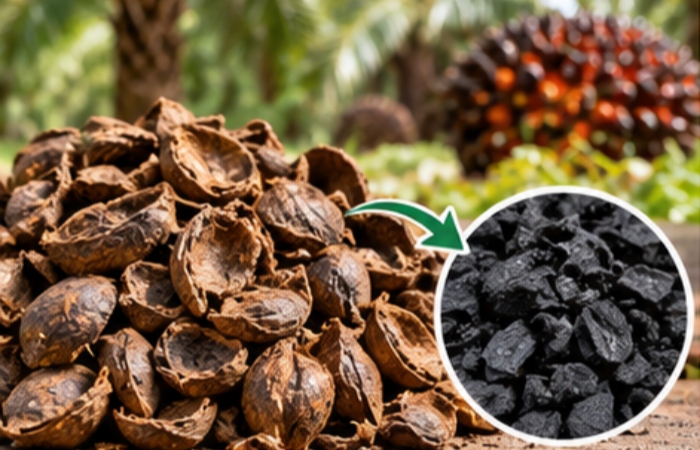 Palm kernel shells and product biochar
Once you have established your daily processing target and expected biochar output, the next step is to select a carbonization system that matches your raw material supply and production schedule.
The choice between batch and continuous carbonization depends on how much PKS is available, how regularly it can be supplied, and how many hours the plant needs to operate.
| Project Requirements | Carbonization Option | Main Characteristics |
|---|---|---|
| Intermittent raw material supply or batch-based production | Batch Carbonization | Processes PKS in separate loading, carbonization, and discharge cycles |
| Stable raw material supply and regular, long-hour production | Continuous Carbonization | Supports continuous feeding and discharge for ongoing production |
Neither option is suitable for every project. The choice should be based on available PKS, daily processing targets, operating hours, and biochar requirements.
For projects requiring continuous production, DOING ECO (Henan DOING) offers a double-cylinder carbonization system. Its inner cylinder performs low-temperature drying and pre-carbonization, while the outer cylinder completes carbonization.
DOING ECO's biomass double-cylinder process uses approximately 500°C and a total residence time of around 50 minutes (Inner drum 20 minutes + Outer drum 30 minutes). This staged process promotes more uniform heating and supports the condensation of carbon-containing structures. Its primary design objective is to improve fixed-carbon yield, with more consistent biochar quality as an additional benefit.
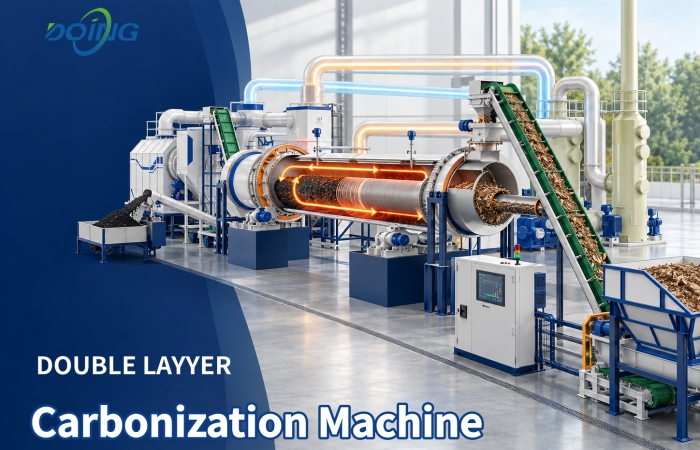 DOING double-cylinder continuous carbonization machine
To configure a suitable palm kernel shell biochar production line, customers should provide PKS photos, moisture content, particle size, daily supply, required processing capacity, and intended biochar application. DOING ECO can then assess the material and recommend the appropriate carbonization machine and auxiliary equipment.
Planning a PKS biochar project? Contact DOING ECO with your raw material and production requirements to discuss a suitable production line.
No. Approximately 500°C and 50 minutes (20 minutes in the inner cylinder and 30 minutes in the outer cylinder) are reference operating parameters for DOING ECO's double-cylinder biomass carbonization machine. Actual operating conditions should be adjusted according to PKS characteristics and the desired biochar properties.
Not all generated gas can necessarily be reused. Only suitable combustible gas can be recovered as a fuel source for the carbonization furnace or dryer. The gas composition, dust removal, and exhaust treatment requirements should be evaluated when designing the gas recovery system.
A trial carbonization test using representative PKS samples is recommended before finalizing the production line. The resulting biochar can be evaluated against the required product characteristics and intended application. This helps determine whether the proposed carbonization conditions are suitable before commercial production begins.
Different PKS sources may have different moisture contents, particle sizes, and impurity levels. These variations can affect pretreatment requirements and carbonization performance. The production line should therefore be configured based on the actual feedstock conditions rather than assuming all PKS can be processed under identical settings.

Please provide us with project information as much as possible.



Copyright © 2015-2026 Doing Holdings - Henan Doing Environmental Protection Technology Co., Ltd | Privacy Policy | All Rights Reserved