
For woody biomass, the key difference between slow pyrolysis and gasification is the product target. Slow pyrolysis prioritizes solid carbon and is therefore suitable for projects focused on biochar production, while the combustible gas generated during the process can also be recovered for usable heat. Gasification puts more emphasis on converting biomass carbon into combustible gas for energy use, so much less solid biochar remains.
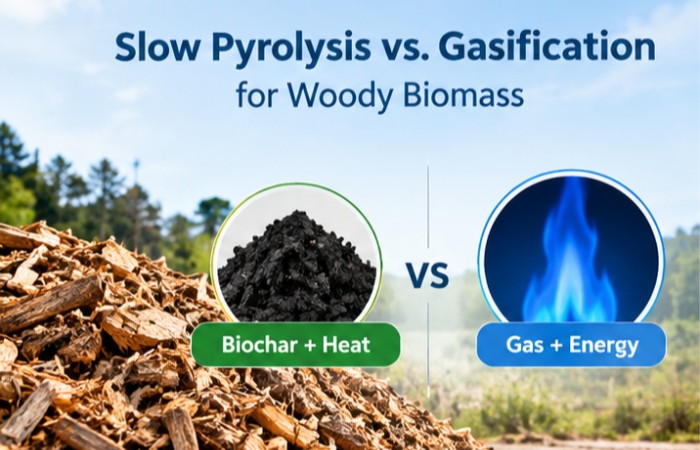 Difference between slow pyrolysis and gasification of woody biomass
So, when a woody biomass project needs both biochar and usable heat, the first question is not simply which technology is “better,” but which product is the primary project objective.
In slow pyrolysis, woody biomass is gradually heated under oxygen-limited conditions, typically around 350–600°C, with a relatively long residence time. This process favors solid biochar formation. For air-dried hardwood, a reference biochar yield is about 25%–35%, although actual results depend on feedstock type, moisture, final temperature and residence time.
The process also produces combustible gas. Instead of treating it only as a by-product, a properly designed system can recover the gas and burn it to support the heating process. This allows slow pyrolysis to combine biochar production with heat recovery.
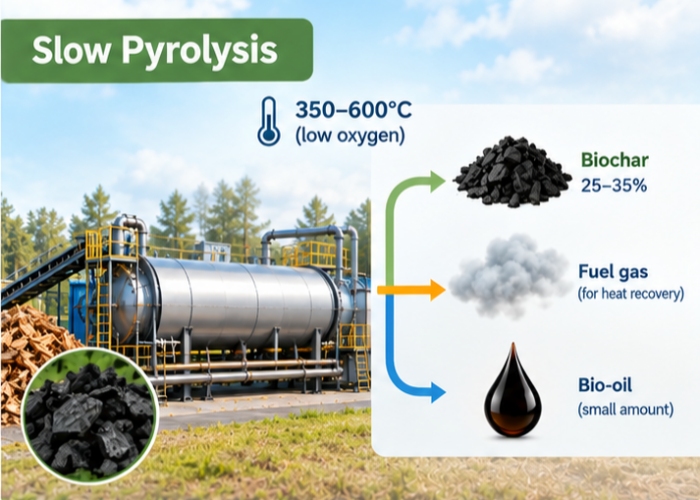 Slow pyrolysis process of wood biomass
After biomass pyrolysis, approximately 80%–90% of the energy is converted into high-grade fuel (biochar + fuel gas + bio-oil). Biochar itself has a considerable calorific value, and the calorific value of wood pellets after carbonization can reach 7000–8000 kcal/kg; the combustible gas produced during the pyrolysis process can also be reused for reactor heating or supplied externally.
Gasification uses a higher-temperature process, typically around 700–1000°C, with a controlled supply of oxygen or another gasification agent. Its main objective is to convert more biomass carbon into combustible gas, with producer gas or syngas becoming the dominant product.
As a result, the solid carbon output is much lower. The reference range in the source material is about 5%–15% biochar or char residue, compared with 25%–35% for slow pyrolysis. The resulting gas can be used for heating or other energy applications.
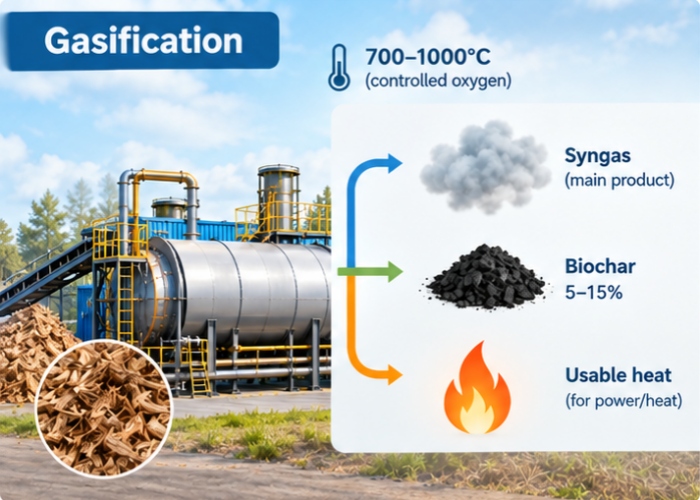 Wood biomass gasification process
Biomass gasification provides the heat required for the reaction through partial combustion, retaining as much energy as possible in the combustible gas. The calorific value of the gasified gas varies depending on the process: approximately 5440–7322 kJ/m³ for air gasification and approximately 10920–18900 kJ/m³ for steam gasification. Gasification systems have high thermal efficiency, making them suitable for direct heating or power generation.
This makes gasification more closely aligned with projects where gas and energy are the main outputs, rather than commercial biochar.
| Factor | Slow Pyrolysis | Gasification |
| Main focus | Biochar + heat recovery | Gas + energy |
| Typical temperature | 350–600°C | 700–1000°C |
| Main product | Solid biochar | Combustible gas |
| Biochar yield | 25–35% | 5–15% |
| Biochar quality | High fixed carbon content; specific surface area up to 763.06 m²/g | Lower calorific value; higher ash content |
| Heat source | Recovered process gas + heat recovery | Larger gas output for energy use |
| Available heat distribution | 80–90% of energy retained in biochar and by-product gas, which can be used separately | Over 70% of energy converted into combustible gases (CO, H₂, CH₄) for direct heat or power generation |
| Typical application | Biochar-focused projects | Energy-focused projects |
| Core product added value | Biochar sells for approximately $188–260/ton; carbon credit revenue can further improve profitability | Gas used directly for heat or power, with lower value per unit of energy than high-value biochar |
The practical distinction is simple: slow pyrolysis keeps more carbon in the solid product, while gasification converts more carbon into gas.
For projects that prioritize biochar while also needing usable process heat, DOING ECO (Henan Doing Environmental Protection Technology Co., Ltd.) provides biomass carbonization and pyrolysis equipment with different process configurations.
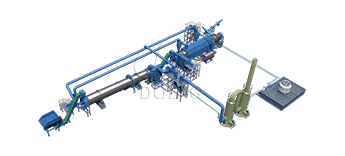
For biochar-focused applications, the Double-cylinder structure uses an inner cylinder and an outer cylinder for different thermal stages. The inner cylinder is responsible for low-temperature drying and pre-pyrolysis, while the outer cylinder handles the main carbonization process. This staged heating design helps the material gradually move through drying, pre-pyrolysis and carbonization, supporting stable biochar production while improving heat utilization.
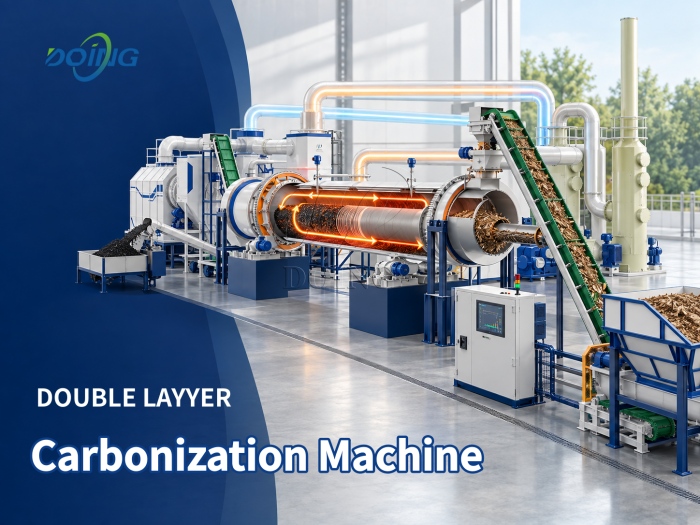 DOING double-cylinder pyrolysis carbonization machine
The combustible gas generated during the carbonization process can also be recovered and routed back to the heating system, helping make better use of process energy.
For projects with stronger gas and heat demand, DOING ECO also describes a single-tube configuration, where biomass directly contacts the high-temperature gas flow. This increases gas production but results in lower solid carbon output.
The suitable configuration depends on the feedstock, moisture, required capacity, target product and available heat demand rather than on one parameter alone.
For woody biomass, slow pyrolysis is more closely aligned with projects where biochar is a main product and usable heat is also required. Gasification is more focused on combustible gas and energy production, with lower solid biochar output.
Therefore, the right process depends on whether your project places greater value on biochar yield or gas/energy utilization.
Planning a wood waste pyrolysis or biomass carbonization project? Contact DOING ECO with your feedstock, moisture, capacity and target product requirements to discuss a suitable process configuration.
The source material identifies wood, sawdust, coconut shell, bamboo and other woody biomass as suitable application materials. Final configuration should be based on the actual feedstock characteristics.
Higher moisture reduces effective dry-feed input and increases the heat required for water evaporation. The source recommends keeping feedstock moisture below 15% and using pre-drying when necessary.
No. Higher temperature generally drives more volatile matter out of the solid product, which can reduce char yield while increasing fixed-carbon content.
Yes. Depending on the biomass to biochar pyrolysis system design, recovered gas can also supply heat to feedstock drying or other on-site heat-demand applications.
Key inputs include feedstock type, moisture, required daily capacity and target product. DOING ECO can use these biomass to biochar/gas production project conditions to evaluate the appropriate process route and configuration.

Please provide us with project information as much as possible.



Copyright © 2015-2026 DOING Holdings - Henan Doing Environmental Protection Technology Co., Ltd | Privacy Policy | All Rights Reserved