
For cities looking to divert sewage sludge from landfill, carbonization offers a practical way to reduce sludge volume while recovering useful energy and producing a carbon-rich solid material. Instead of treating sludge only as a waste that needs disposal, a properly designed sewage sludge carbonization system can use the organic content in sludge as part of the energy source for the process.
The main challenge is that sewage sludge usually contains high moisture and requires controlled thermal treatment. The system therefore needs to manage drying, carbonization, combustible gas, dust, and emissions as one integrated process.
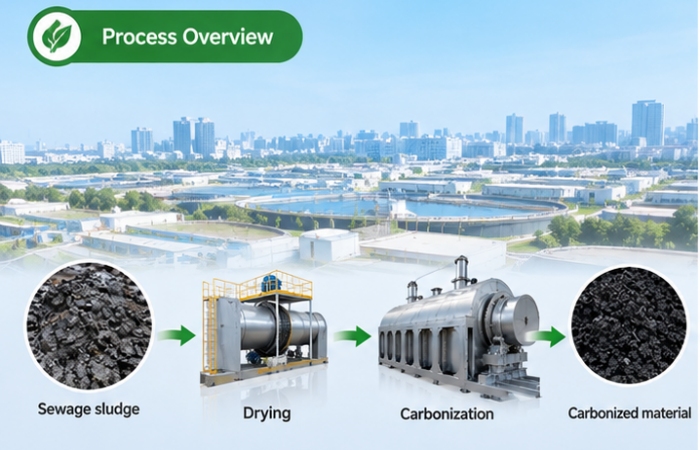 Sewage sludge carbonization process
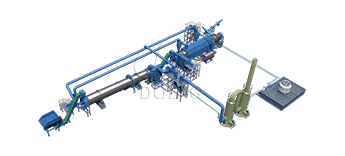
For this type of application, DOING ECO provides continuous carbonization solutions that combine sludge drying, controlled carbonization, combustible gas utilization, and environmental control.
Moisture is one of the first issues to address. Wet sludge requires substantial heat simply to evaporate water, so directly feeding high-moisture sludge into a carbonization furnace is inefficient. A drying stage is normally used before carbonization to bring the feedstock to a suitable moisture level.
After drying, the sludge enters the carbonization reactor under controlled oxygen-limited conditions. The organic components are thermally decomposed and converted into a carbon-rich solid, while combustible gases are released during the process.
A practical sewage sludge carbonization system therefore needs to coordinate several stages:
Sludge feeding → drying → continuous carbonization → gas combustion/heat recovery → cooling and discharge → gas and dust treatment
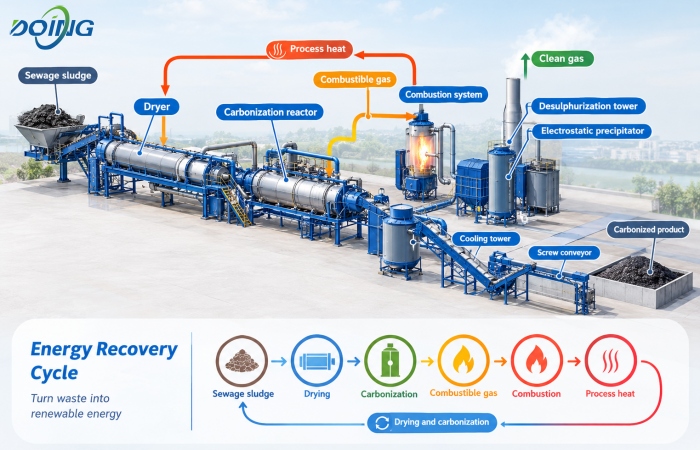 Carbonization with heat recovery
This integrated design helps keep the thermal process stable while reducing the amount of material that ultimately requires disposal.
A key advantage of continuous carbonization is that the combustible gas generated during carbonization does not have to be treated simply as waste gas. After appropriate combustion and process control, its heat can be reused to support the drying and carbonization stages.
This creates an internal heat-recovery cycle:
Sewage sludge → drying → carbonization → combustible gas → combustion → process heat → drying and carbonization
Once the system reaches stable operating conditions, part of the energy demand can be supported by the gas generated from the feedstock itself. This reduces dependence on external fuel and makes the process more suitable for continuous operation.
DOING ECO's continuous carbonization equipment uses a controlled heating structure and gas reuse design. The carbonization furnace generally operates around 480–550°C, with operating conditions adjusted according to the feedstock and process requirements. A slight negative-pressure environment helps control gas flow and reduce the risk of uncontrolled leakage.
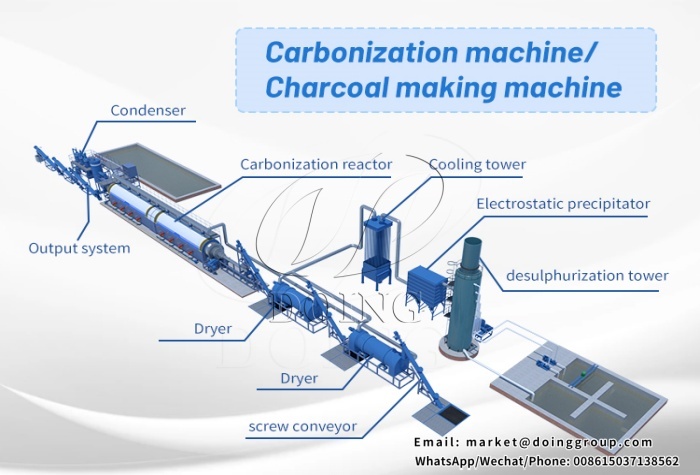 DOING ECO complete carbonization system
The equipment can also be equipped with PLC control and pulse dust removal, allowing operators to monitor and manage important operating parameters while controlling particulate emissions.
For cities handling a continuous stream of sewage sludge, batch processing can make stable throughput and heat management more difficult. A continuous system is better suited to applications where sludge is generated every day and needs to be processed on an ongoing basis.
DOING ECO's continuous carbonization technology is designed for industrial-scale operation, with typical capacities in the 1–5 t/h range. For example, a 1 t/h model can theoretically process about 24 tons of sludge per day, or approximately 7,920 tons per year, based on 24-hour operation and 330 operating days per year. Larger customized systems can be engineered according to the project's feedstock and throughput requirements.
The system can provide several practical benefits:
Reduced sludge volume: Carbonization converts much of the organic fraction into a smaller amount of carbon-rich solid material.
Energy recovery: Combustible gas generated during carbonization can be combusted and reused as process heat.
Controlled thermal treatment: Drying and carbonization are managed as connected stages rather than separate operations.
Continuous operation: Suitable for municipal or industrial facilities with a steady sludge supply.
Emission control: Dust collection and controlled gas combustion help manage emissions from the thermal process.
Automated operation: PLC-based control can simplify monitoring of temperature, feeding, and other key operating parameters.
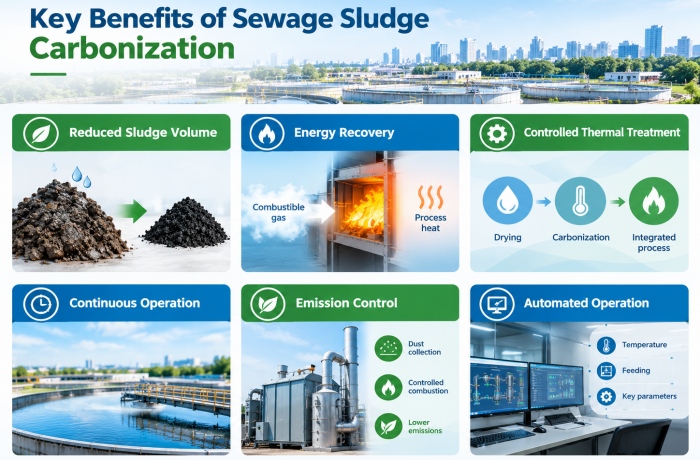 Key benefits of sludge carbonization
The final carbonized material can then be further evaluated according to its composition and the intended application. Its use should be determined based on local regulations and laboratory testing, particularly when the original sludge contains contaminants or heavy metals.
The appropriate sludge carbonization equipment depends on more than the desired capacity. Before selecting a system, several feedstock and project conditions should be established:
Feedstock moisture: Sludge moisture directly affects drying energy consumption and overall system efficiency.
Processing capacity: The required hourly throughput determines the size and configuration of the drying and carbonization equipment.
Sludge composition: Organic content, ash content, contaminants, and other characteristics influence the carbonization process and the properties of the final solid.
Energy balance: The amount and calorific value of combustible gas generated from the sludge should be considered when designing the heat-recovery system.
Emission requirements: Local regulations determine the appropriate gas combustion, dust removal, and other environmental-control measures.
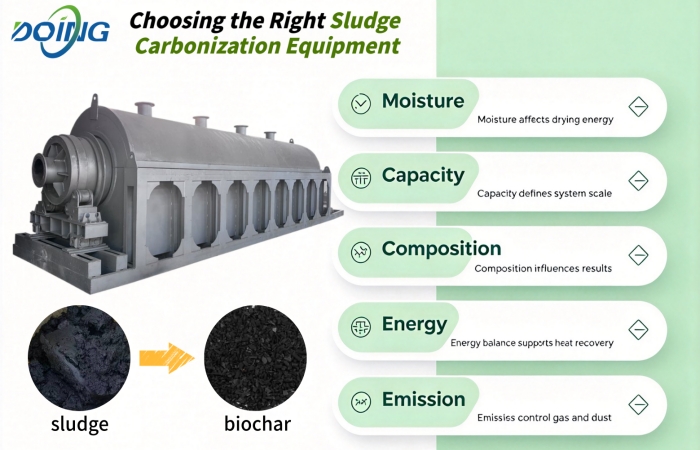 Choosing the right carbonization system
For this reason, a sewage sludge project should be designed around the actual sludge analysis rather than selecting a standard machine based only on capacity.
DOING ECO can provide the equipment and engineering design according to the customer's sludge characteristics, required capacity, moisture level, and local operating requirements. Feedstock testing can also help determine the appropriate drying and carbonization parameters before final system design.
If your city is planning to divert sewage sludge from landfill, DOING ECO can help evaluate the sludge characteristics and design a suitable sewage sludge carbonization system, including drying, continuous carbonization, gas energy recovery, and environmental-control equipment. Contact DOING ECO with your sludge moisture, daily volume, and target capacity for a project-specific solution.
High-moisture sewage sludge normally needs to be dried before entering the carbonization stage. Reducing moisture first lowers the energy required for evaporation and helps maintain stable carbonization conditions.
The initial start-up may require an external heat source. During stable operation, however, combustible gas generated during carbonization can be combusted and reused to provide process heat, reducing the need for continuous external fuel.
The gas can be collected and directed to a controlled combustion system. Its heat can then be reused for drying and carbonization instead of being wasted.
DOING ECO's carbonization systems generally operate in the range of 480–550°C, with the actual operating temperature adjusted according to the characteristics of the sludge and the required process conditions.
This cannot be determined from carbonization alone. The final material should be tested for heavy metals, contaminants, and other relevant parameters, and its application must comply with local regulations and standards.
Yes. System configuration can be designed around the sludge moisture, composition, required processing capacity, energy conditions, and environmental requirements of the project.

Please provide us with project information as much as possible.



Copyright © 2015-2026 DOING Holdings - Henan Doing Environmental Protection Technology Co., Ltd | Privacy Policy | All Rights Reserved