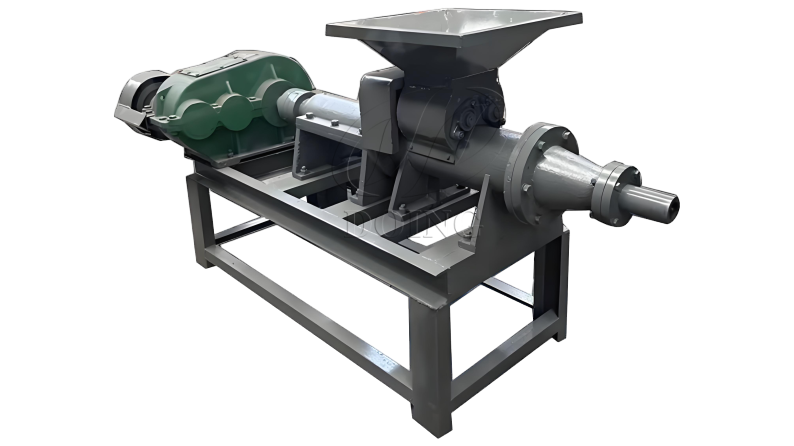

For many continuous biomass carbonization systems, a particle size of around 20–30 mm is a practical starting range before carbonization. However, the actual requirement may vary depending on the biomass type, particle shape, moisture, bulk density, feeding system, and carbonization furnace design.
The goal is not to make biomass as small as possible. The key is to prepare a relatively uniform feedstock that can be fed continuously and heated consistently in the carbonization system.
For many common biomass feedstocks, 20–30 mm can be used as a practical starting reference. Fine materials such as sawdust and rice husk may require less size reduction.
| Feedstock | Recommended Starting Size | Key Consideration |
| Wood chips | 20–30 mm | Remove oversized chips for more uniform feeding |
| Bamboo | 20–30 mm | Cut long fibers before crushing |
| Coconut shell | 20–30 mm | Crush large pieces and screen oversized particles |
| Agricultural stalks | 20–30 mm | Cut long stalks before size reduction |
| Sawdust | 5–15 mm | Usually needs screening rather than heavy crushing |
| Rice husk | 5–15 mm | Usually fine enough; focus on stable feeding |
These are practical starting references rather than universal specifications. The final feed size should be confirmed according to the actual biomass and the selected continuous carbonization machine.
Particle size affects how biomass is fed, heated, and carbonized. The main considerations are heat transfer, feeding stability, carbonization consistency, and grinding energy.
Heat needs to move from the heated environment into the biomass particles. Larger particles generally require more time for heat to penetrate into their center.
If oversized pieces are mixed with much smaller particles, different parts of the feedstock may heat at different rates, which can affect carbonization uniformity. A relatively controlled particle size helps provide more consistent heating conditions.
Continuous carbonization systems require a steady supply of biomass. Large chunks, long fibers, and highly irregular materials can interfere with hoppers, conveyors, or screw feeding systems. More uniform particles are generally easier to transport and feed continuously.
This is particularly important for fibrous materials such as bamboo, corn stalks, cotton stalks, and other agricultural residues.
The particle size distribution affects how quickly individual particles reach the required carbonization conditions.
When the feedstock contains very different particle sizes, smaller particles may heat faster while oversized pieces may require more time. A more consistent feed size can therefore help maintain stable operating conditions and more uniform carbonized products.
Smaller does not always mean better. Grinding biomass significantly below the required feed size increases electricity consumption, equipment wear, and the amount of fine material generated.
The practical target is: Large enough to avoid unnecessary grinding, but small and uniform enough for stable feeding and effective heat transfer.
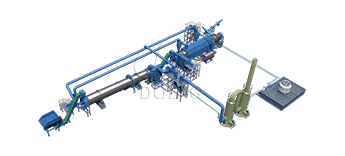
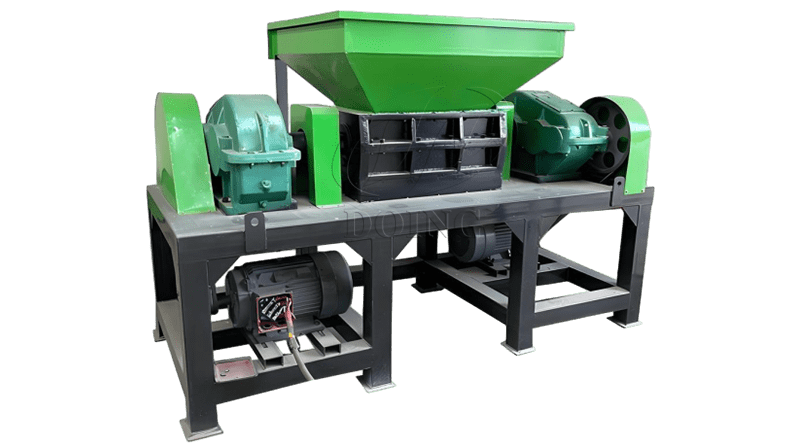
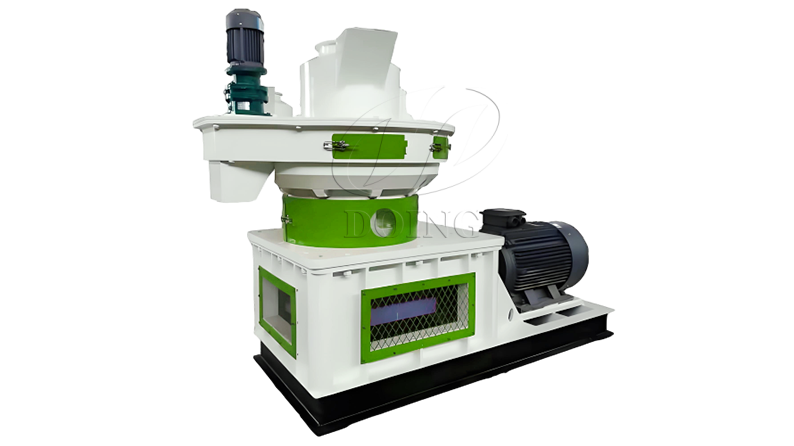
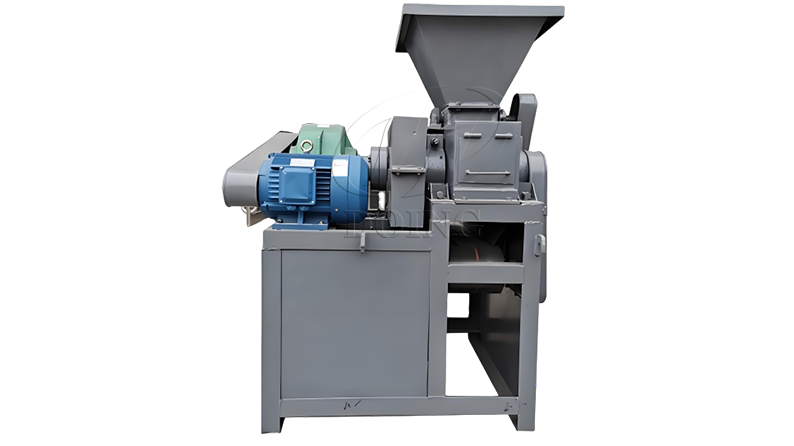
The basic preparation method is: Cutting / Crushing → Screening → Drying → Pelletizing, if required → Feeding → Continuous Carbonization
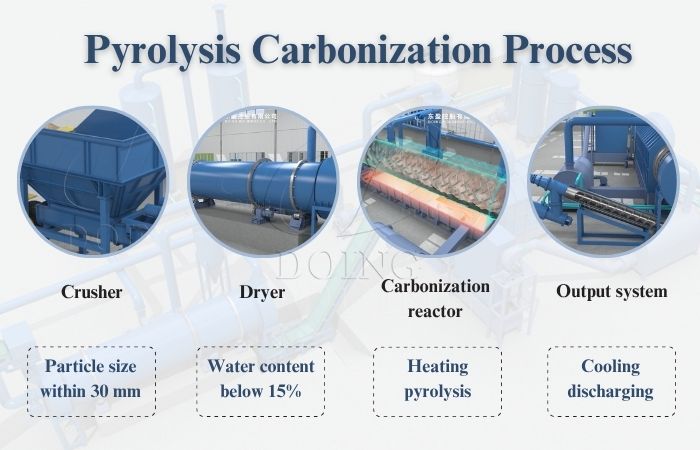 Biomass continuous carbonization process
Not every biomass needs every step. As an equipment manufacturer, Henan Doing Environmental Protection Technology Co., Ltd (DOING ECO) combines over 15 years(till 2026) of experience in equipment R&D, production, and project installation to consistently provide suitable carbonization machine solutions tailored to the specific biomass carbonization needs of its clients. DOING ECO selects the preparation process according to the material’s original size, structure, density, moisture, and feeding characteristics.
| Biomass | DOING ECO Preparation Route | Main Purpose |
| Wood waste | Chipping → Crushing → Screening → Drying | Reduce oversized pieces and obtain a consistent feed |
| Bamboo | Cutting → Crushing → Screening → Drying | Shorten long fibers and control particle size |
| Coconut shell | Crushing → Screening → Drying | Break hard shells and remove oversized pieces |
| Agricultural stalks | Cutting → Crushing → Screening → Drying | Reduce long fibers and improve feeding |
| Loose agricultural residues | Crushing → Screening → Drying → Pelletizing | Increase bulk density when direct feeding is unstable |
| Sawdust | Screening → Drying → Feeding | Avoid unnecessary crushing when the material is already fine enough |
| Rice husk | Screening → Drying → Feeding or Pelletizing | Consider densification when direct feeding is difficult |
For oversized biomass, the material can be crushed and then screened. Oversized particles can be returned for secondary crushing, while qualified particles continue to drying and feeding.
Pelletizing is an optional step. It is mainly considered for loose, low-density biomass when densification can improve feeding stability.
In this way, DOING ECO does not apply one fixed pretreatment process to all biomass. The equipment combination is matched to the actual feedstock and continuous carbonization requirements.
For many continuous biomass carbonization applications, a feedstock moisture content of around 10–15% is a practical target. Higher moisture increases the energy needed to evaporate water and can affect the stability and efficiency of the carbonization process. The final requirement should be confirmed according to the specific biomass and equipment design.
No. Pelletizing is mainly useful for loose or low-density materials that are difficult to feed consistently. Dense or already free-flowing biomass may not require pelletizing.
Particle size can affect heating behavior and carbonization conditions, but charcoal yield is also influenced by feedstock composition, moisture, carbonization temperature, residence time, and other operating parameters. Particle size should therefore be considered as one part of the overall process.
Dried biomass should be protected from rain and excessive humidity to prevent moisture from increasing again before feeding. Storage conditions should also minimize contamination by soil, stones, and other foreign materials.
In many cases, yes. However, different agricultural residues may require different pretreatment and operating conditions. A suitable process should account for changes in particle size, moisture, density, and material structure between feedstocks.
The suitable feed size depends on the biomass type, original particle size, moisture content, bulk density, and required processing capacity. Send your biomass information to DOING ECO, and we can evaluate the appropriate cutting, crushing, screening, drying, pelletizing, feeding, and continuous carbonization process for your project.

Please provide us with project information as much as possible.



Copyright © 2015-2026 DOING Holdings - Henan Doing Environmental Protection Technology Co., Ltd | Privacy Policy | All Rights Reserved