
Chicken manure can be turned into a useful carbon-rich product through carbonization, but buying a carbonization machine for this application requires more than checking its capacity and price.
Before making an investment, buyers should look closely at odor and emissions control, dust management, fire and gas safety, and the machine’s ability to operate under controlled conditions. These factors affect not only environmental compliance but also the stability and long-term operating cost of the plant.
For chicken manure carbonization projects, a practical chicken manure carbonization machine should keep the carbonization process enclosed, control the combustible gas generated during heating, manage dust from dry feedstock and char, and minimize uncontrolled emissions. This is where the design of the biomass carbonization equipment becomes particularly important.
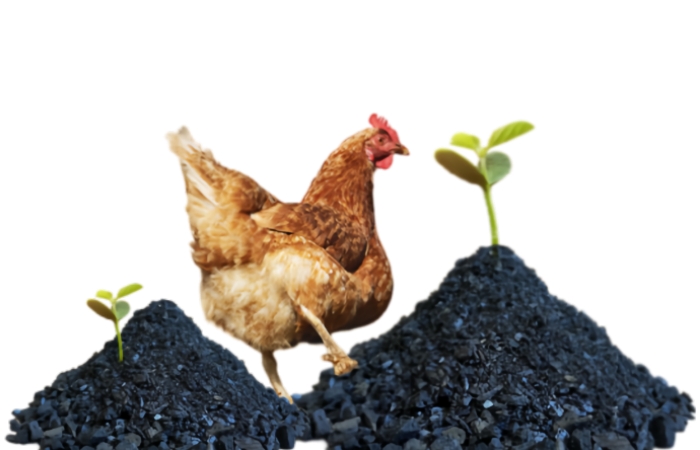 Chicken manure and carbonized chicken manure
Chicken manure has a strong odor before processing, and drying and carbonization can generate additional gases, vapors and fine particles. A carbonization machine should therefore be designed around a controlled, enclosed process rather than simply heating the material in an open or poorly sealed system.
There are several points worth checking with a supplier:
Enclosed feeding and carbonization process: This helps reduce the release of odor and process gases into the workshop.
Dust handling: Dry chicken manure and finished char can generate fine particles during conveying, feeding and discharge.
Process gas treatment or reuse: The supplier should clearly explain where the combustible gas goes after it is generated.
Dust removal system: This is especially important for commercial-scale plants where large quantities of dry material are continuously processed.
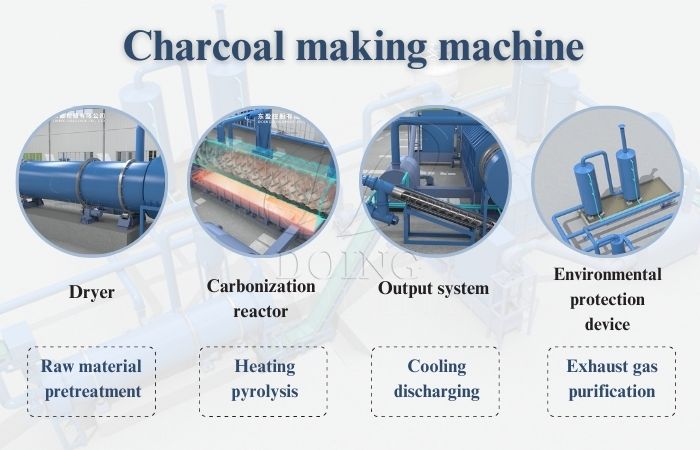 Chicken manure carbonization process
DOING ECO's continuous carbonization system uses a relatively enclosed process and incorporates pulse dust removal to help control particulate emissions during chicken manure carbonization. The system is also designed to recover combustible syngas generated during carbonization and reuse it as a heat source after startup.
This approach is important because environmental performance should not depend entirely on adding treatment equipment after the carbonization furnace. The process design itself should help control emissions from the beginning.
Safety is another key issue when choosing a chicken manure carbonization machine for carbonizing chicken manure or other biomass materials.
During carbonization, organic material is heated in a low-oxygen environment and produces combustible gases. If these gases accumulate or enter areas where oxygen is present, they can create a fire or explosion risk. Fine organic dust can also present additional risks in a biomass-processing plant.
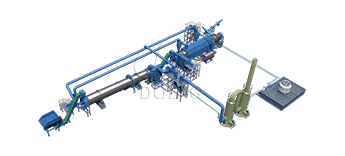
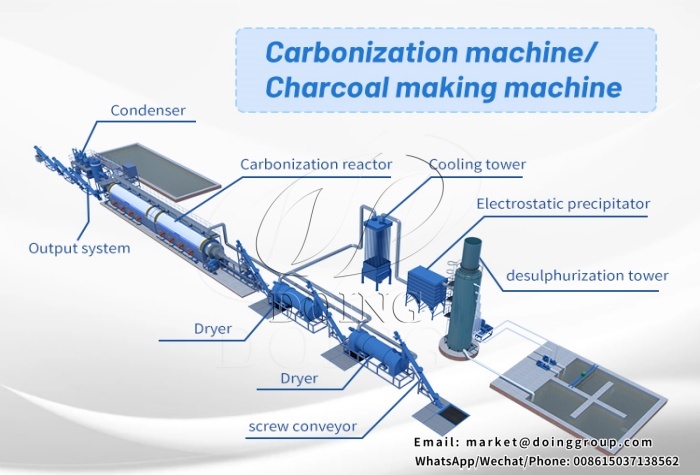 Complete carbonization equipment system
Before buying a machine, pay attention to the following safety points:
Carbonization furnace sealing: The furnace should maintain controlled sealing conditions during operation.
Combustible gas collection and transportation: The system should provide a defined route for collecting and transporting the generated gas.
Gas introduction into the combustion system: The gas utilization process should be properly designed and controlled.
Abnormal pressure and temperature handling: The system should have appropriate measures for dealing with abnormal operating conditions.
Oxygen control: Measures should be in place to reduce oxygen entering the carbonization zone.
Dust and hot char management: The discharge process should safely handle dust and hot carbonized material.
A properly designed system should keep the carbonization zone under controlled operating conditions and avoid uncontrolled gas release.
DOING ECO's equipment uses the combustible syngas generated during carbonization as part of the heating system. After the system starts up, the recovered gas can be burned to provide heat for the carbonization process. This reduces dependence on external fuel while also providing a defined route for the combustible gas generated during operation.
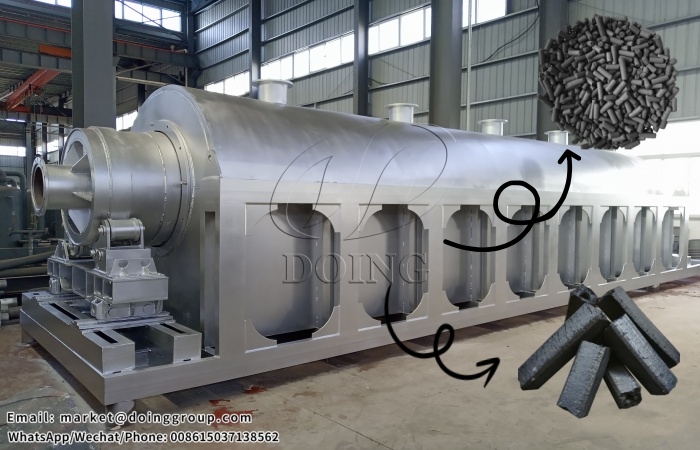 DOING ECO carbonization furnace
Temperature control is equally important. DOING ECO's continuous carbonization equipment typically operates at around 500°C, with the actual operating conditions adjustable according to the feedstock and desired product characteristics. A residence time of more than 50 minutes allows the material to remain in the carbonization zone under controlled conditions.
For buyers, the key point is simple: safety should be evaluated based on how the entire system handles gas, heat, pressure, oxygen and dust, rather than the furnace alone.
Environmental requirements can vary by country, region and project location, so there is no single emissions standard that applies to every chicken manure carbonization project.
Before purchasing equipment, confirm the requirements that apply to your site, including:
Permitted emissions and air-pollution requirements
Odor-control requirements
Dust and particulate-emission limits
Requirements for combustible gas and thermal equipment
Wastewater requirements, if any auxiliary process generates wastewater
Requirements for handling and storing the final carbonized product
This is particularly important because carbonization itself is only one part of the project. Drying, feeding, gas combustion, dust collection, char cooling and product storage can all affect the plant's environmental performance.
A supplier should therefore be able to discuss the complete process and the configuration of the biomass carbonization equipment, rather than quoting only the furnace price.
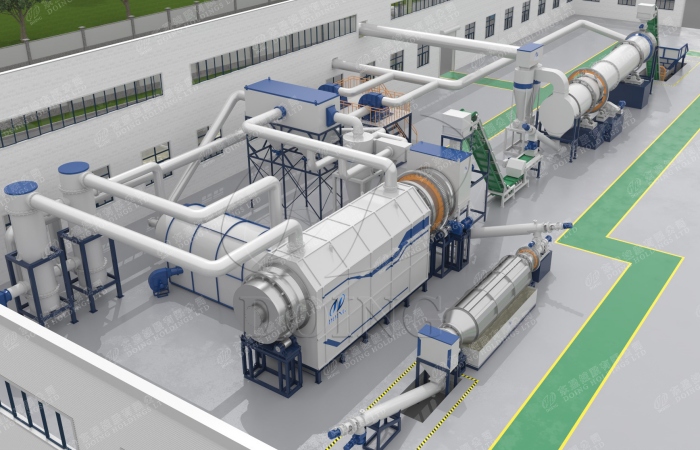 Continuous carbonization equipment
DOING ECO's equipment uses a double-cylinder structure: the inner cylinder is used for preheating and moisture removal, while the outer cylinder provides the main carbonization heating. This arrangement helps make better use of heat within the system and supports continuous operation.
For chicken manure, feedstock conditions should also be discussed before the equipment is selected. Moisture content, processing capacity, operating hours and the required characteristics of the final biochar can all affect the equipment configuration.
A good way to compare suppliers is to review specific technical information instead of comparing machine prices alone.
At minimum, pay attention to the following technical points:
Feedstock: The system should be suitable for chicken manure with your actual moisture and particle characteristics.
Capacity: The realistic processing capacity should be based on chicken manure rather than another type of biomass.
Temperature: The recommended carbonization temperature range and temperature-control method should be clearly defined.
Residence time: The material residence time in the carbonization zone should be confirmed.
Gas handling: The collection, combustion and reuse of combustible syngas should be clearly explained.
Dust control: The equipment configuration should include appropriate particulate collection.
Sealing: The system should minimize air leakage into the carbonization zone.
Energy consumption: External fuel requirements during startup and normal operation should be clarified.
Product quality: The expected characteristics of the resulting biochar should be defined according to the proposed process.
Project customization: Feeding, drying, carbonization, cooling and dust-removal systems should be configurable according to the actual project.
These points help buyers identify whether they are purchasing simply a furnace or a chicken manure carbonization machine and complete carbonization solution designed for continuous industrial operation.
DOING ECO provides continuous biomass carbonization equipment with customized configurations based on feedstock, capacity and product requirements. The system can incorporate drying, feeding, carbonization, gas reuse, cooling and dust-removal processes, allowing the environmental and safety considerations to be addressed as part of the overall plant design.
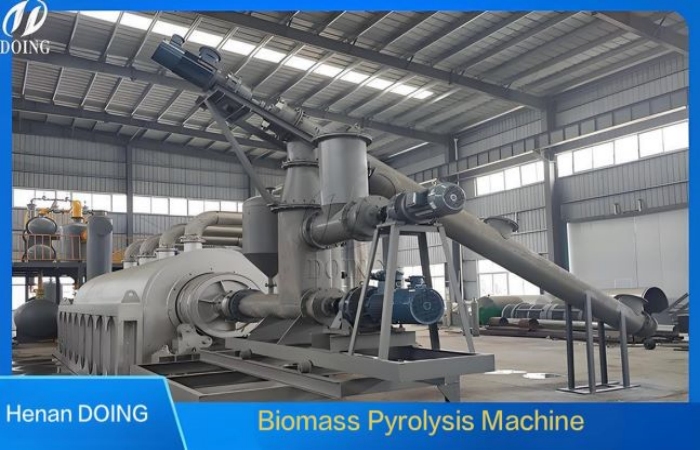 DOING ECO carbonization equipment
If you are considering chicken manure carbonization, send DOING ECO your daily or hourly processing capacity, chicken manure moisture content, expected operating hours and target biochar requirements.
DOING ECO can evaluate the feedstock and help develop a carbonization system around your actual project conditions, including process configuration, gas utilization and dust-control requirements.
Yes. Chicken manure can be processed through carbonization to produce a carbon-rich solid material. However, its relatively high moisture content means that drying and feedstock preparation should be considered when designing the carbonization system.
Yes. Carbonization of organic materials generates combustible gases as the feedstock is heated. A properly designed system should collect and manage these gases rather than allowing them to accumulate or escape uncontrolled. In DOING ECO's system, combustible syngas can be recovered and reused as a heat source for the carbonization process after startup.
Dust can be generated during feeding, conveying, drying, carbonization and char discharge. A suitable system can use enclosed conveying and feeding together with dust-removal equipment to reduce particulate emissions. DOING ECO's carbonization systems can be equipped with pulse dust removal for this purpose.
A supplier will normally need information such as chicken manure moisture content, required processing capacity, operating hours, feedstock condition, project location and target biochar specifications. These details help determine the drying, feeding, carbonization and cooling configuration.
External fuel may be required during startup, depending on the system configuration. Once carbonization is established, combustible syngas generated by the process can be recovered and reused for heating in systems designed for gas utilization. This can reduce the need for external fuel during normal operation.
Look beyond the equipment price and ask for details about furnace sealing, temperature control, combustible-gas handling, dust removal, cooling, emergency measures and the complete process configuration. It is also useful to ask whether the supplier has experience designing systems according to different feedstocks and project conditions.

Please provide us with project information as much as possible.



Copyright © 2015-2026 DOING Holdings - Henan Doing Environmental Protection Technology Co., Ltd | Privacy Policy | All Rights Reserved