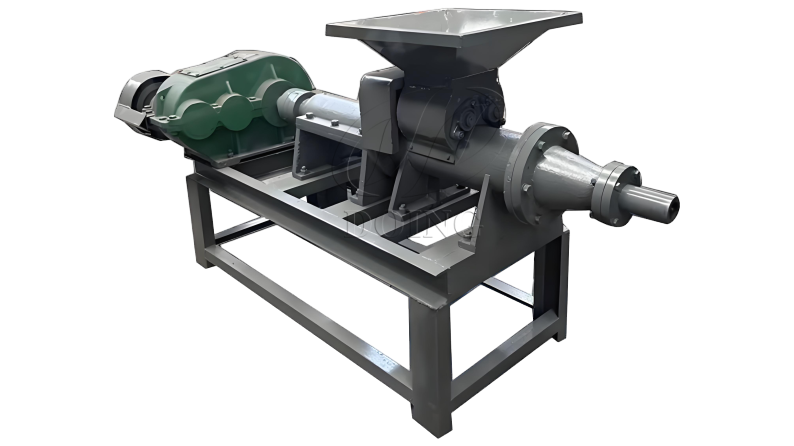

Traditional charcoal kilns can turn crop residues into char, but they are often designed for relatively simple, small-scale production. When the goal is crop residue to biochar production from rice husk, straw, corn stalks, palm residues, or other agricultural waste at a more consistent commercial scale, other technologies can offer better control over the process.
The main alternatives to traditional charcoal kilns include continuous carbonization equipment, rotary carbonization systems, retort-type systems, and other controlled pyrolysis technologies. Among these options, a continuous carbonization system is particularly suitable when stable feedstock throughput, heat recovery, and consistent carbonization conditions are important.
The main difference between traditional kilns and modern carbonization equipment is how closely the carbonization process can be controlled.
Traditional fixed kilns generally rely on batch operation and manual control. They can be relatively simple to build, but temperature distribution, oxygen control, carbonization time, and product quality can vary between batches. They may work for small-scale operations where production consistency is less critical.
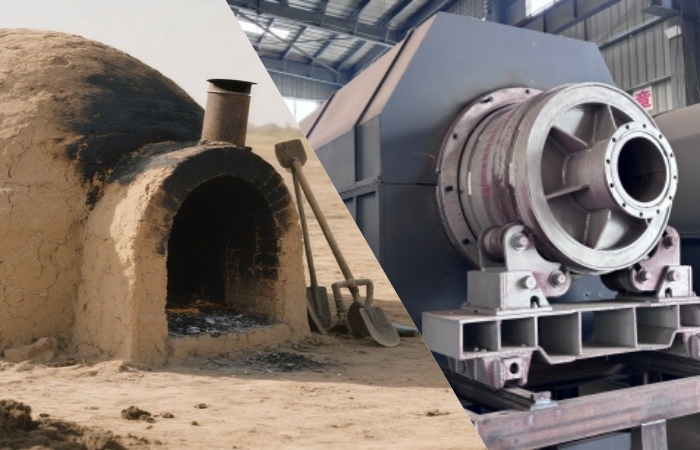 Modern systems offer better process control for biochar production
Retort systems isolate the biomass from direct combustion and provide better control of the carbonization environment. They can improve product consistency, but the system is still commonly designed around batch or semi-continuous operation. Rotary carbonization systems use a rotating chamber to move biomass through the heating zone. They can handle continuous feeding and are suitable for some types of biomass, although equipment configuration needs to match the feedstock's moisture, particle size, and bulk density.
Continuous carbonization equipment continuously feeds prepared biomass into a controlled carbonization chamber. This approach is useful for projects that need steady production rather than repeated loading, heating, cooling, and unloading cycles. For crop-residue biochar projects, the right choice depends on feedstock characteristics, required capacity, moisture content, target biochar properties, and operating conditions—not simply the name of the technology.
Crop residues can vary significantly in moisture, particle size, density, and composition. Rice husk, straw, coconut shell, palm residues, bamboo, and similar materials therefore need different pretreatment and operating conditions.
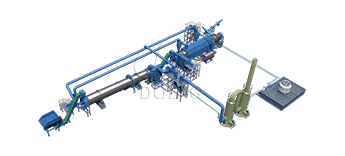
A modern continuous carbonization line typically includes drying, feeding, carbonization, cooling, gas recovery, and biochar discharge. Drying is especially important because excessive moisture consumes heat and can reduce carbonization efficiency. For many biomass applications, the feedstock is preferably dried to around 8–15% moisture before entering the carbonization furnace.
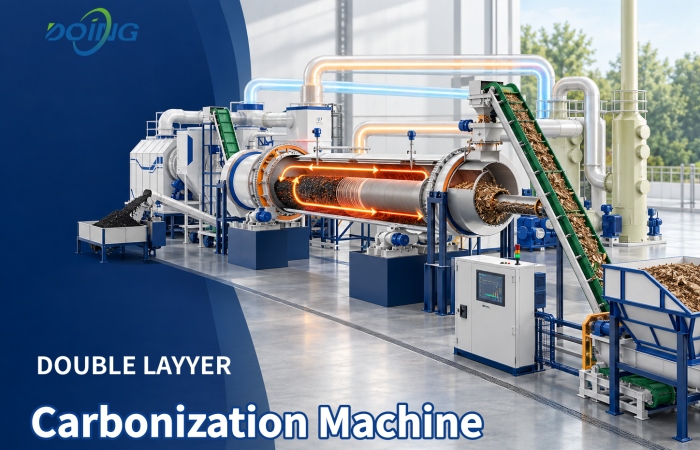 Double-cylinder design supports continuous biomass carbonization
DOING ECO's continuous carbonization equipment uses a double-cylinder structure. The inner cylinder is used for biomass preheating and moisture removal, while the outer cylinder provides the main pyrolysis and carbonization environment. This arrangement allows heat generated during the process to be reused rather than relying entirely on external fuel. The combustible gas produced during carbonization can also be recovered and used to provide heat for the system. This helps reduce dependence on additional fuel once the equipment reaches stable operating conditions.
For larger projects, DOING ECO can configure continuous carbonization equipment around the actual feedstock and required throughput. Typical equipment capacities are available from around 1–5 tons per hour, with larger customized systems possible for specific projects. For example, a model described as xxxDY-1Ton/Hour has a nominal processing capacity of about 1 ton per hour. Depending on operating hours and feedstock conditions, this can correspond to approximately 24 tons per day at 24-hour operation or about 7,200 tons per year based on 300 operating days. Actual output should be calculated according to the feedstock and project operating schedule.
Replacing a traditional kiln with industrial carbonization equipment is not simply a matter of choosing a larger furnace. Several practical parameters determine whether the system will perform as expected.
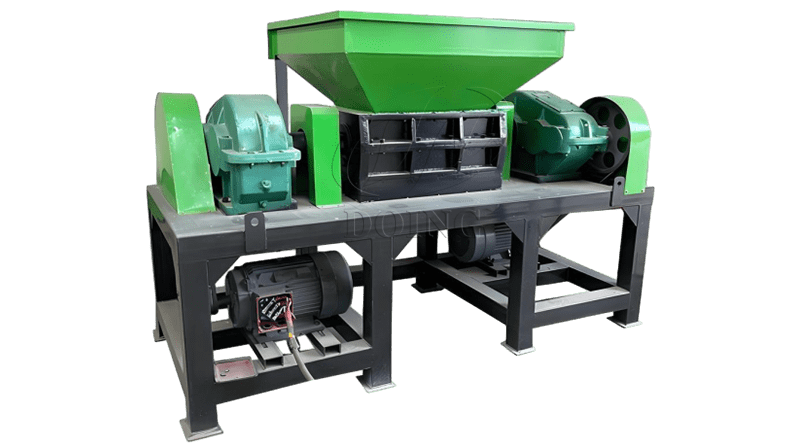
Feedstock preparation is one of the first points to check. Crop residues with high moisture may require a dryer, while oversized or irregular materials may need crushing or screening. Particle size and bulk density also affect feeding stability and heat transfer.
Carbonization temperature and residence time are also important. DOING ECO's continuous systems generally operate around 480–550°C, with the actual temperature adjusted according to the feedstock and desired biochar characteristics. Controlled residence time helps maintain more stable carbonization conditions than a manually operated kiln.
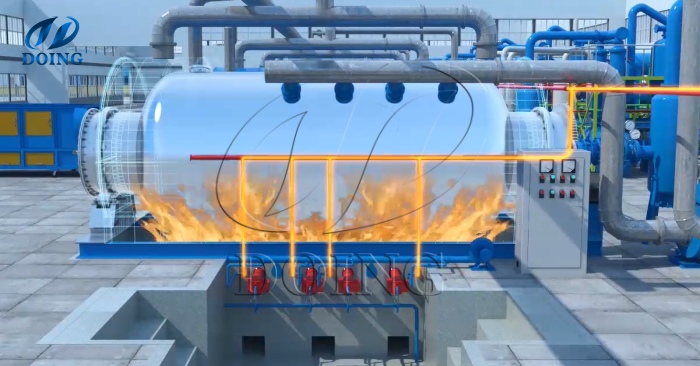 Recovered combustible gas provides heat for carbonization
Heat recovery and gas utilization should be considered. Instead of allowing combustible carbonization gas to escape, a properly designed system can recover and burn the gas as a heat source for the carbonization process. This can reduce external fuel consumption and make continuous operation more practical.
Emission control and operating safety need to be part of the system design. Carbonization produces combustible gases, dust, and other exhaust components, so the system should include appropriate gas handling, dust removal, temperature monitoring, and pressure control. DOING ECO's carbonization systems use PLC-based control and operate under slight negative pressure to help maintain stable process conditions.
For projects requiring documented environmental performance, DOING ECO also has third-party testing data covering pollutants such as SO₂, NOx, CO, particulate matter, HCl, HF, heavy metals, and dioxins. The specific emission results depend on the complete system configuration and operating conditions.
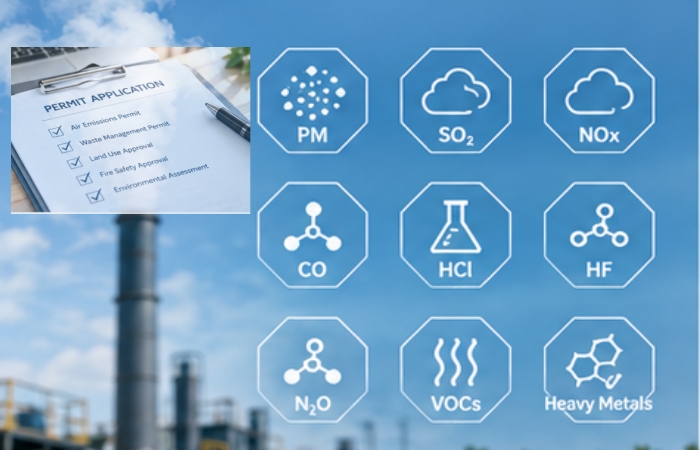 Third-party testing supports emissions performance assessment
The best alternative to a traditional charcoal kiln depends on the project's actual operating requirements. A small operation with limited feedstock and low production requirements may still find a simple batch kiln practical. A commercial project that needs continuous production, more consistent carbonization, and better energy utilization may benefit from a continuous carbonization plant.
For crop residues such as rice husk, straw, palm residues, coconut shells, bamboo, and other biomass, the equipment should be selected after evaluating the feedstock's moisture, particle size, bulk density, required capacity, operating hours, and target biochar properties.
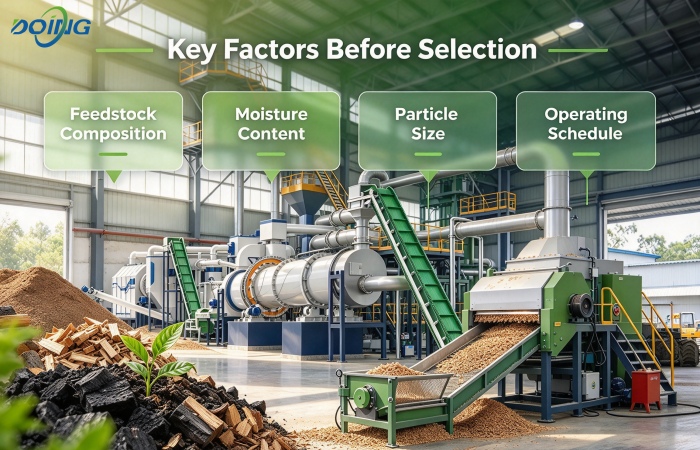 Factors for equipment selection
DOING ECO provides customized biomass carbonization equipment and solutions based on these parameters rather than applying one standard configuration to every project. The system can integrate feedstock pretreatment, drying, continuous carbonization, combustible-gas recovery, cooling, and biochar discharge according to project requirements.
If you are considering replacing a traditional kiln with a continuous biochar production system, providing your feedstock type, moisture content, required capacity, and expected operating hours is enough for the initial equipment assessment.
Continuous carbonization equipment, retort systems, rotary carbonization systems, and other controlled pyrolysis technologies can be used as alternatives. The appropriate option depends on feedstock and production requirements.
Yes. Rice husk, straw, palm residues, coconut shells, bamboo, and other biomass can be processed in continuous systems when their moisture, particle size, and feeding characteristics are suitable.
For many biomass applications, a moisture content of around 8–15% is preferred before carbonization. High-moisture materials may require additional drying.
The combustible gas generated during carbonization can be collected and burned as a heat source for the carbonization process, reducing the need for external fuel during stable operation.
The key information includes feedstock type, moisture content, particle size, bulk density, required processing capacity, operating hours, and the intended use or specifications of the biochar.

Please provide us with project information as much as possible.



Copyright © 2015-2026 DOING Holdings - Henan Doing Environmental Protection Technology Co., Ltd | Privacy Policy | All Rights Reserved