
For most biomass feedstocks, a moisture content of around 10%-15% is generally suitable for continuous carbonization. However, the ideal moisture range can vary depending on the feedstock type, particle size, processing capacity, and carbonization system design. When the moisture content is too high, additional drying is usually recommended before the material enters the continuous carbonization machine.
Moisture has a direct effect on the heating efficiency and operating stability of a carbonization system.
When wet biomass enters a carbonization machine, part of the heat must first be used to evaporate water instead of heating the biomass. Excessive moisture can therefore lead to:
- Higher energy consumption
- Longer heating time
- Lower thermal efficiency
- Reduced processing efficiency
- More difficult temperature control
- Unstable carbonization results
For this reason, controlling feedstock moisture before carbonization is an important part of biomass pretreatment.
| Feedstock Moisture | General Recommendation |
| Below 10% | Usually acceptable, but additional drying may increase cost |
| 10%-15% | Generally suitable for continuous carbonization |
| 15%-20% | May be workable depending on the feedstock and machine |
| Above 20% | Pre-drying is generally recommended |
Yes. Different biomass feedstocks have different structures, densities, and initial moisture levels.
Common materials such as sawdust, wood chips, rice husk, coconut shell, palm kernel shell (PKS), bamboo, EFB, and agricultural residues may require different pretreatment conditions.
For example, loose agricultural residues may retain more moisture than dense shells, while larger particles may require more time for moisture removal. Therefore, the appropriate moisture target should be determined together with the feedstock characteristics and the carbonization system.
When the raw material contains excessive moisture, drying should be carried out before carbonization. Common drying methods include:
Suitable for small-scale production and areas with favorable weather conditions. It has low operating costs but requires more space and depends heavily on climate.
A rotary dryer is more suitable for continuous industrial production. It can provide more consistent and controllable drying for large quantities of biomass.
For continuous carbonization plants, hot air or recovered process heat can be used for feedstock drying. This can help improve overall thermal efficiency and reduce additional energy consumption.
For customers working with high-moisture biomass, DOING ECO can integrate a drying process before the continuous carbonization machine.
The general process is: Raw biomass -> Moisture testing -> Drying -> Moisture control -> Continuous carbonization -> Charcoal discharge
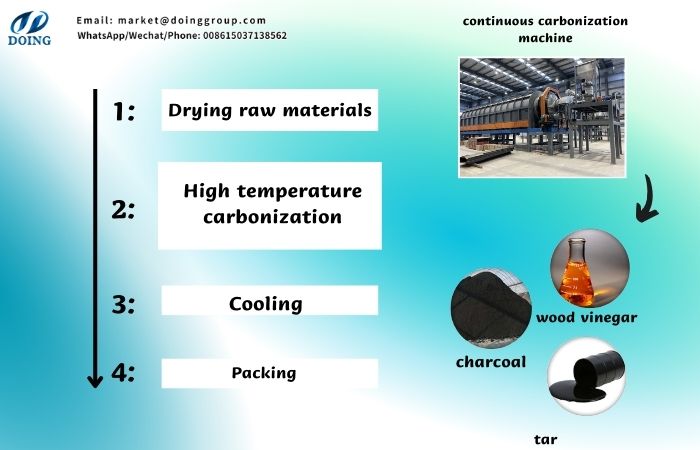 Continuous carbonization charcoal making process
When DOING ECO engineers develop a complete continuous carbonization system configuration, they consider the following factors:
1. Biomass Moisture Control and Carbonization Conditions:
- The denser the raw material (such as coconut shell and palm kernel shell), the stricter the moisture requirement. A longer residence time and a relatively higher carbonization temperature are generally required;
- The looser and lighter the raw material (such as straw and rice husk), the faster the carbonization reaction and the shorter the required residence time. High temperature for too long should be avoided, otherwise the charcoal may be oxidized and burned off, reducing the yield;
- Adjustment logic for moisture fluctuations: when feedstock moisture increases, first reduce the feed rate to extend residence time. If necessary, increase the temperature of the preheating section rather than directly increasing the temperature of the main carbonization section.
2. Biomass Carbonization Atmosphere: The continuous carbonization process maintains oxygen-deficient (low-oxygen) pyrolysis throughout the process. Large amounts of air ingress should be prevented to reduce finished charcoal burn-off and improve fixed carbon yield.
3. Based on the industry standard NY/T 4161-2022, Technical Specification for Biomass Pyrolysis Carbonization Process, together with field measurements from industrial carbonization equipment installed by DOING, the following moisture ranges and process guidelines can be applied to different biomass feedstocks:
| Feedstock Type | Moisture Control Range | Process Guidelines |
| Fine wood chips and sawdust | 10%-15% | Carbonization temperature: 580-630°C; constant-temperature residence time in the furnace: 30 minutes; finished charcoal fixed carbon content can reach more than 78%. |
| High-ash, lightweight straw feedstock | ≤12% | Pre-treat the feedstock to remove impurities; carbonization temperature: 480-600°C; reduce the feed rate to minimize losses caused by dust carrying charcoal particles. |
| Hard shells such as coconut shell and walnut shell | 8%-16% | Increase the carbonization temperature to 550-720°C and extend the residence time in the furnace to ensure thorough pyrolysis of dense materials. |
| High-tar bamboo pieces and strips | 10%-15% | Use a pre-feeding structure to prevent bridging and a tar pretreatment module, with segmented temperature control to match the pyrolysis requirements. |
| Loose sawdust and straw | 8%-20% | The pyrolysis rate is fast, so the upper moisture limit can be moderately relaxed. The corresponding feed speed should be matched to prevent excessively rapid pyrolysis. |
As a carbonization equipment manufacturer, DOING ECO focuses not only on the carbonization furnace itself but also on the overall material preparation and production process. The drying and carbonization system can be designed according to the customer's feedstock type, initial moisture, required capacity, particle size, and final product requirements. This helps customers obtain a more stable operating condition when processing biomass with variable moisture content.
Feedstock that is too wet can increase energy consumption, slow heating, and make temperature control more difficult. Feedstock that is excessively dry may increase drying cost without providing a proportional practical benefit. The goal is not simply to achieve the lowest possible moisture, but to reach a suitable level for stable and efficient carbonization.
There is no single moisture value that is perfect for every biomass material. A practical evaluation should consider: Feedstock type + Initial moisture + Particle size + Processing capacity + Carbonization system
Before selecting a machine, it is recommended to test the actual moisture content of the feedstock and determine whether pre-drying is required.
If you are unsure whether your biomass is suitable for direct feeding, a supplier can evaluate the feedstock condition and recommend the appropriate drying and carbonization configuration.
For feedstocks with suitable moisture, the material may be prepared for direct feeding based on the actual system design. For high-moisture feedstocks, DOING ECO can combine a drying system with continuous carbonization. For variable raw material conditions, the pretreatment process and carbonization parameters can be customized according to the feedstock characteristics.
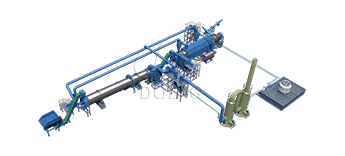
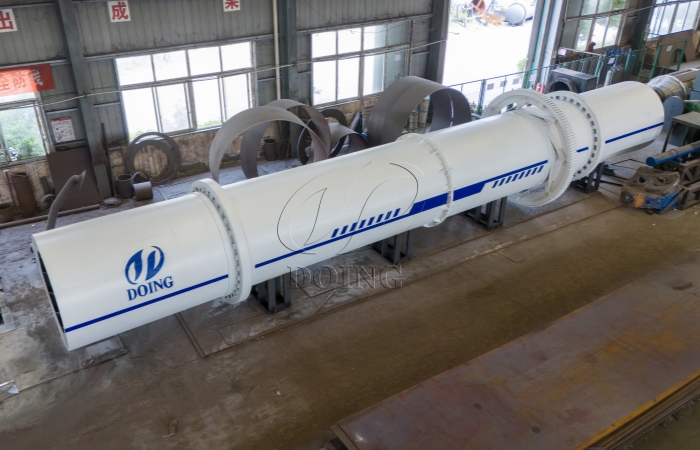 DOING biomass carbonization dryer system
This approach allows customers to select a complete biomass carbonization solution rather than a carbonization machine alone.
A moisture content of around 10%-15% is generally a suitable target for many biomass feedstocks used in continuous carbonization. However, the final recommended moisture level should be determined according to the specific raw material and equipment configuration.
Proper moisture control can improve heating efficiency, operating stability, and overall carbonization performance. For high-moisture biomass, adding a suitable drying system before carbonization is often the most practical solution.
DOING ECO provides continuous carbonization solutions and customized drying configurations for different biomass feedstocks. Contact us with your feedstock type, moisture content, and required capacity to discuss a suitable solution.
It depends on the feedstock and machine design. When moisture is too high, pre-drying is generally recommended to improve thermal efficiency and carbonization stability.
Yes. Excessive moisture increases the amount of energy required to evaporate water and can affect heating conditions, which may influence the overall carbonization process and product output.
A suitable moisture meter or laboratory moisture test can be used. For equipment selection, testing representative samples of the actual feedstock is recommended.
Yes. In a properly designed continuous system, recovered heat can potentially be utilized for feedstock drying, helping improve overall energy utilization.
Yes. Particle size affects drying speed, heat transfer, and residence time. The feedstock size should therefore be considered together with moisture content when designing the carbonization process.

Please provide us with project information as much as possible.



Copyright © 2015-2026 DOING Holdings - Henan Doing Environmental Protection Technology Co., Ltd | Privacy Policy | All Rights Reserved