
A biomass carbonization plant typically costs about $100,000 to more than $1 million, depending on processing capacity, feedstock, moisture content, automation, environmental systems and the scope of the project.
For a small commercial plant, the investment may be closer to the lower end of this range. A larger continuous plant with drying, automatic feeding, gas and dust treatment, cooling and other supporting systems can require several hundred thousand dollars or more. The key point is that the price of a biomass carbonization machine is not the same as the total cost of a biomass carbonization plant. A machine quotation may cover only the main carbonization furnace, while a complete project can also include drying, feeding, conveying, environmental protection, electrical control, installation and other supporting systems.
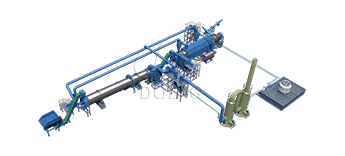
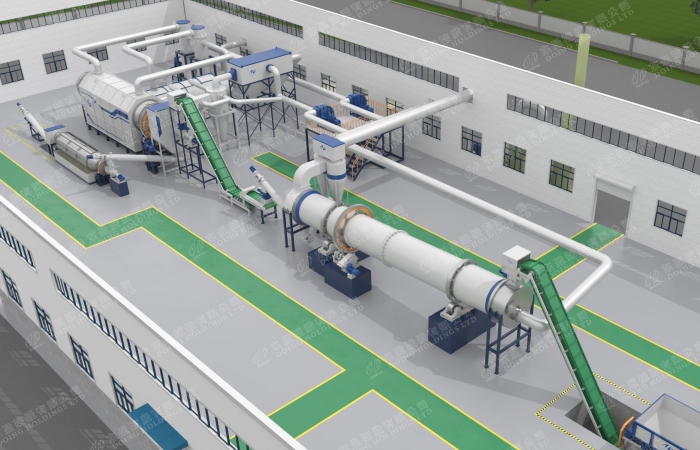 Continuous biomass carbonization equipment in a factory
The following figures can be used as a preliminary budgeting reference. They are not fixed market prices, and actual costs vary according to feedstock, equipment configuration, local conditions and the supplier's scope of supply.
| Project scale | Typical capacity | Preliminary budget |
| Small commercial | 0.5–1 t/h | About $100,000–$250,000 |
| Medium commercial | 1–3 t/h | About $200,000–$500,000 |
| Larger industrial | 3–5 t/h | About $400,000–$1 million+ |
These are indicative ranges rather than formal quotations. Land, major civil works and some local installation costs may be excluded depending on the project. This is why two suppliers can quote very different prices for plants with similar capacities. One quotation may cover the main equipment only, while another may include a more complete system.
For example, a 1 t/h biomass carbonization machine and a 1 t/h complete carbonization plant should not be expected to have the same price. The latter may include a dryer, feeding system, dust removal, cooling, PLC control, installation and commissioning.
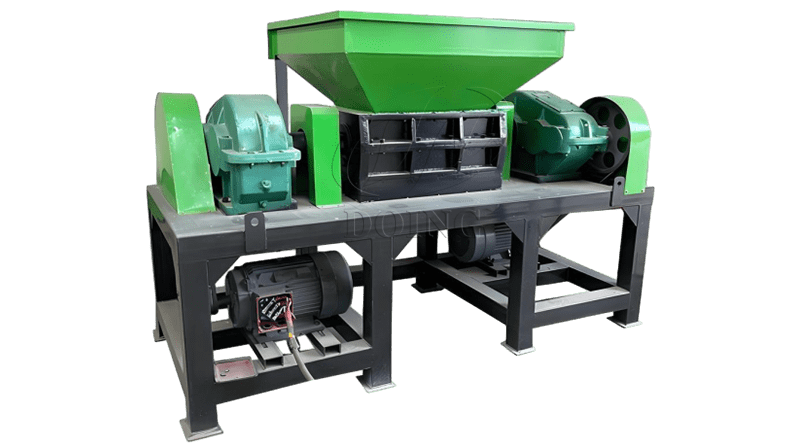
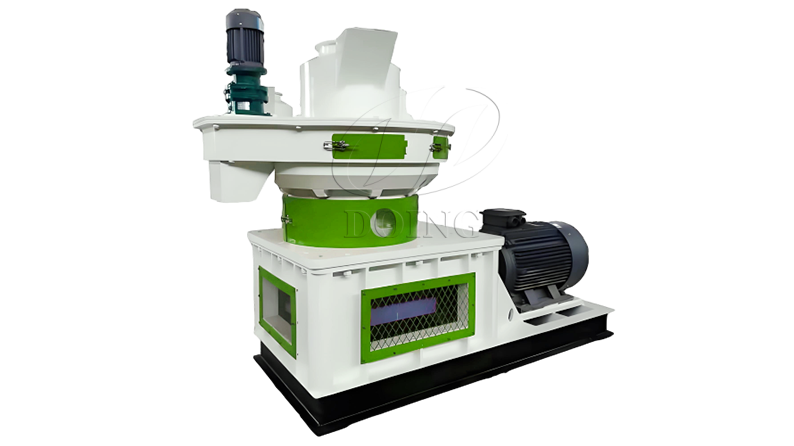
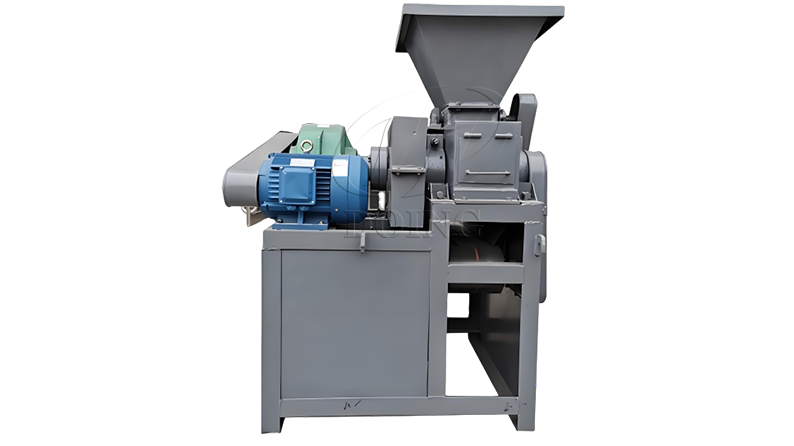
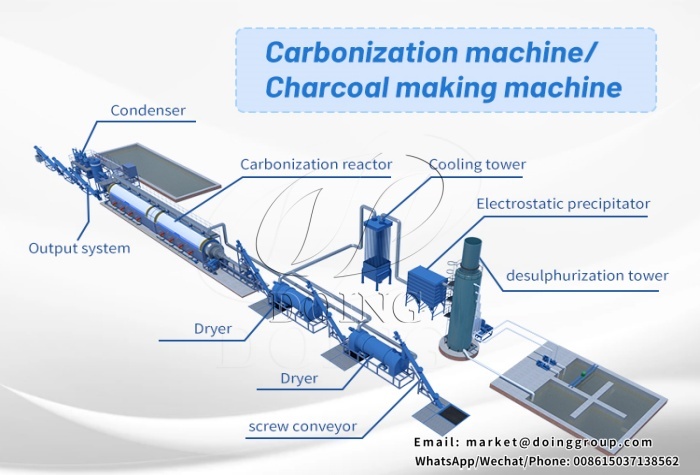 Main equipment of a biomass carbonization plant
The total investment in a biomass carbonization plant is more than the price of the main carbonization machine. A complete project may include plant construction, carbonization equipment, installation and commissioning, environmental facilities, transportation and initial operating costs.
Equipment is usually the largest investment, while construction costs such as foundations, workshops and utilities depend mainly on the project location. Installation, electrical work, operator training and spare parts may also need to be included. Environmental systems are another important part of the budget. Depending on the process and local requirements, the plant may need dust collection and process-gas treatment equipment.
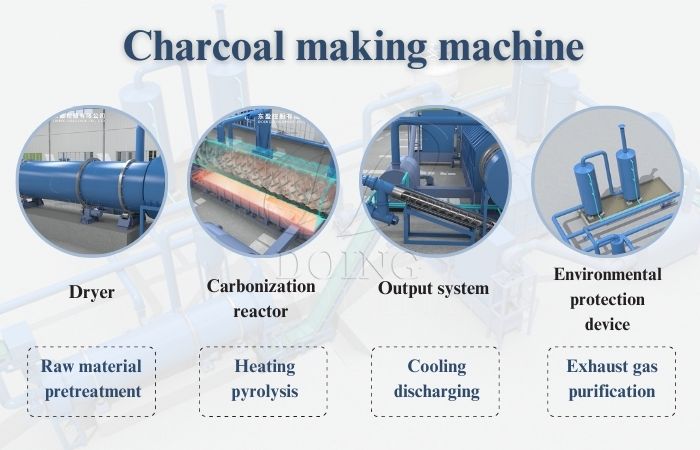 Biomass carbonization process from feeding to discharge
Therefore, when comparing project budgets, make sure you know whether a quotation covers equipment only or the complete plant.
The price of the core biomass carbonization equipment mainly depends on capacity, feedstock, moisture, technology, automation and environmental requirements.
Capacity has a direct effect on equipment size and investment. Feedstock also matters: coconut shells, PKS, EFB, sawdust and wood chips have different physical characteristics, which can change the requirements for crushing, drying and feeding. Higher moisture generally means a larger drying system.
Technology and automation also affect the price. Continuous systems, PLC control and higher automation usually require greater initial investment, while environmental equipment and specific charcoal or biochar requirements can further change the configuration.
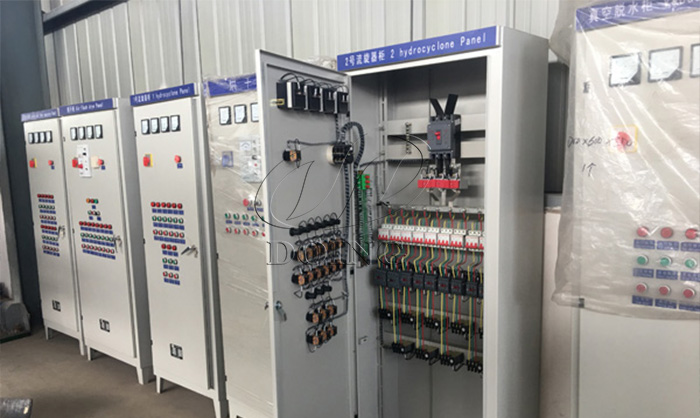 PLC system for automatic process control
For this reason, capacity alone is not enough to determine biomass carbonization equipment cost. A reliable quotation should be based on the actual feedstock and production requirements.
When several suppliers provide different prices, the cheapest quotation is not necessarily the lowest-cost solution.
Start by checking whether each quotation includes the same major systems: carbonization equipment, drying, feeding and conveying, gas and heat management, environmental protection, cooling, electrical control, installation and commissioning. Also check shipping, installation engineers, training, spare parts and warranty terms.
For instance, a supplier quoting $180,000 for the main carbonization equipment may appear cheaper than one quoting $300,000 for a complete system. But if the second quotation already includes the dryer, feeding system, dust removal, PLC control and commissioning, the difference may be much smaller than it first appears.
A reliable supplier should also be able to provide a feedstock-specific proposal rather than simply offering a standard machine.
Before requesting a quotation, it is useful to provide:
Feedstock: coconut shells, PKS, EFB, sawdust, wood chips or other biomass
Moisture: average moisture content
Capacity: required tonnes per hour
Working hours: operating hours per day
Product requirement: charcoal or biochar specifications
Project location: country and basic site information
These details allow suppliers to recommend the appropriate configuration and provide a more realistic biomass carbonization plant cost.
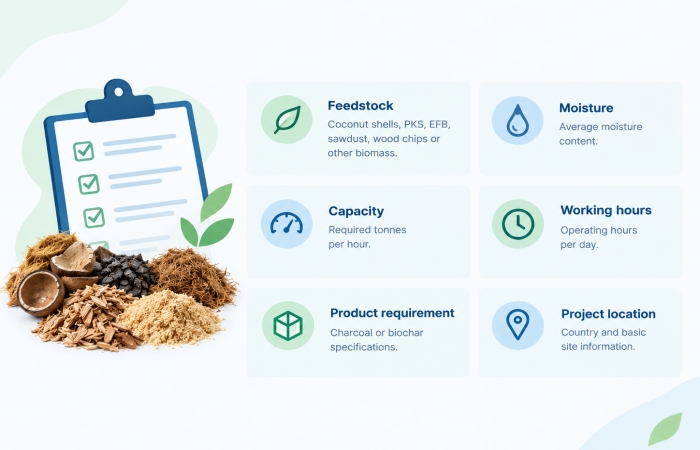 Key information needed for a plant quotation
It is also important to consider more than the initial equipment price. Installation, energy consumption, labor, maintenance and expected production capacity all affect the long-term economics of the project.
For industrial applications, DOING ECO primarily offers medium- to large-scale continuous carbonization equipment with capacities ranging from approximately 1 to 5 t/h, with larger, customized systems available to meet specific project requirements. DOING ECO can design carbonization solutions capable of processing 20 to 120 tons of biomass per day. Additionally, we offer small-scale carbonization equipment, enabling industry newcomers to conduct carbonization trials and feasibility analyses. Plant configurations can be tailored to the feedstock's moisture content, particle size, and required capacity. Depending on the project, the solution can integrate drying, feeding, continuous carbonization, gas reuse, cooling, dust removal, and PLC control systems.
| DOING Standard Configuration and Equipment Quotation for Continuous Carbonization | ||
| System Category | Equipment Name | Core Parameter Configuration |
| Feeding & Conveying Unit | Sealed Belt Conveyor | Variable-frequency speed control; enclosed dust-proof structure |
| Drying Pretreatment Unit | Rotary Drum Dryer | Heated by recovered flue-gas waste heat; reduces feedstock moisture content to 8%–15% |
| Continuous Carbonization Main Unit | Horizontal Enclosed Rotary Carbonization Furnace | Independent temperature control by zone; carbonization temperature 480–550°C; temperature control accuracy ±20°C; slightly negative-pressure environment inside the furnace |
| Flue Gas Waste Heat Recovery Unit | Flue Gas Waste Heat Recovery Heat Exchanger | Overall thermal energy utilization rate ≥83%; recovers pyrolysis flue-gas waste heat for the drying section |
| Char Cooling & Discharge Unit | Enclosed Water-Cooled Char Discharge Machine | Fully enclosed structure; water cooling; discharge temperature ≤50°C; dynamic air-lock design |
| Tail Gas Purification Unit | Spray Tower + Dust Removal & Purification System | Multi-stage harmless treatment; particulate removal efficiency ≥98%; compliant tail gas emissions |
| Intelligent Electrical Control Unit | PLC Automatic Intelligent Control System | Siemens PLC main controller; automatic operation 24/7; supports remote monitoring and parameter adjustment |
| Safety Protection Unit | Explosion-Proof Panels + Multi-Point Sensor Components | Real-time monitoring of furnace temperature and pressure; automatic warning under abnormal conditions; three-level safety protection |
For industrial applications, DOING ECO offers continuous carbonization equipment from about 1 to 5 t/h, with larger customized systems available according to project requirements. The plant configuration can be adapted to the feedstock's moisture, particle size and required capacity. Depending on the project, the solution can integrate drying, feeding, continuous carbonization, gas reuse, cooling, dust removal and PLC control.
If you are planning a biomass carbonization project, send DOING ECO your feedstock, moisture content, required capacity, working hours, product requirements and project location. Based on these details, DOING ECO can evaluate the suitable carbonization system and provide a more specific equipment configuration and project cost estimate.
Not necessarily. Compare the equipment scope, capacity, automation, environmental systems, installation and expected operating costs before making a decision.
A preliminary budget may be around $100,000–$250,000, but the actual price depends on the equipment scope, feedstock, moisture, automation and installation requirements.
Yes. High-moisture biomass usually requires more drying capacity and thermal energy, which can increase both initial investment and operating costs.
A machine quotation may cover only the main furnace. A complete plant can also include drying, feeding, conveying, cooling, environmental systems, electrical control, installation and commissioning.
At minimum, provide your feedstock, moisture content, required capacity, working hours, product requirements and project location. These details help the supplier determine the appropriate equipment configuration and cost.
Not necessarily. Compare the equipment scope, capacity, automation, environmental systems, installation and expected operating costs before making a decision.

Please provide us with project information as much as possible.



Copyright © 2015-2026 DOING Holdings - Henan Doing Environmental Protection Technology Co., Ltd | Privacy Policy | All Rights Reserved