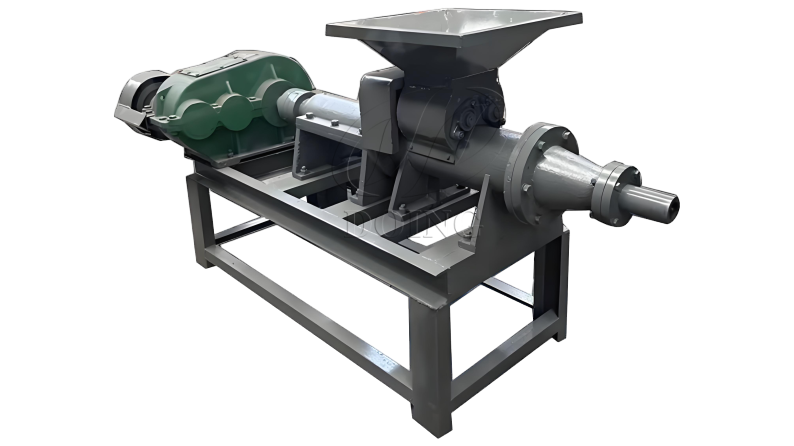

If you have 20 tons of palm kernel shells (PKS) per day and plan to convert them into biochar, a 1–2 t/h continuous carbonization system is generally a practical starting point. The exact equipment capacity depends on your operating hours, PKS moisture content, particle size, and the required biochar properties.
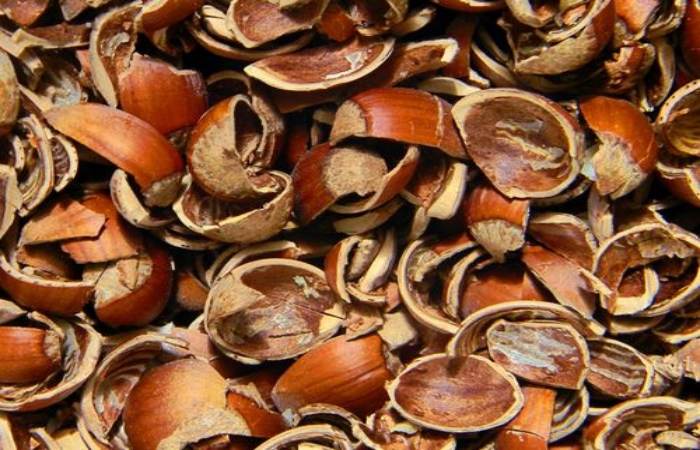 Palm kernel shell feedstock
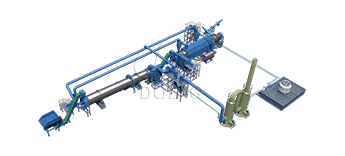
For this scale, palm kernel shell pyrolysis equipment should be selected based on the actual hourly feed rate rather than daily volume alone. A complete PKS biochar production line may include feeding, drying, continuous carbonization, combustible gas utilization, biochar cooling, and discharge. For this production scale, continuous equipment can provide more stable and convenient operation than repeatedly loading and unloading a batch furnace.
The first step is to convert the daily feedstock volume into an hourly processing capacity.
If the plant operates continuously for 24 hours:
20 tons/day ÷ 24 hours ≈ 0.83 tons/hour
However, designing the equipment exactly around 0.83 t/h leaves little room for downtime, maintenance, or fluctuations in feedstock supply. If the plant operates fewer hours per day, the required capacity increases.
For example:
| Daily PKS feed | Operating time | Required average capacity |
| 20 tons/day | 24 h/day | ~0.83 t/h |
| 20 tons/day | 20 h/day | 1.0 t/h |
| 20 tons/day | 16 h/day | 1.25 t/h |
Therefore, a 1–2 t/h continuous carbonization system can provide a reasonable capacity range for a 20-ton/day PKS project.
The final equipment selection should be based on actual feedstock conditions rather than daily tonnage alone. PKS moisture content, particle size, bulk density, and the number of operating hours all affect the required system capacity. For a project specifically focused on palm kernel shell biochar production, these parameters also help determine whether the line needs additional drying, crushing, or screening equipment before carbonization.
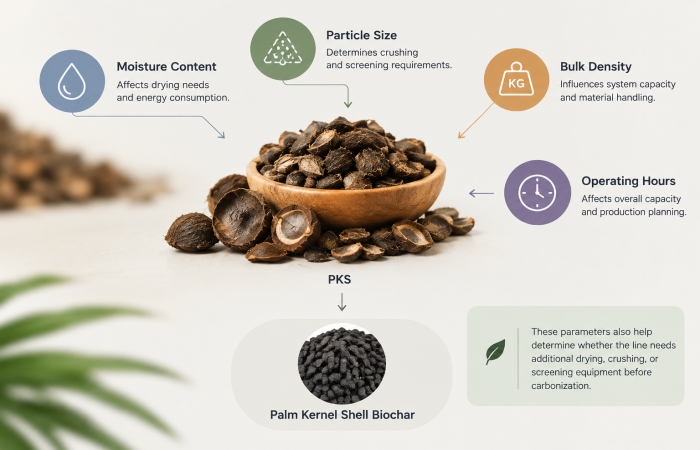 Key carbonization factors
A commercial PKS biochar production line normally involves several stages rather than a carbonization furnace alone. The main components of palm kernel shell pyrolysis equipment can be configured according to the feedstock condition and production target.
Feed Preparation
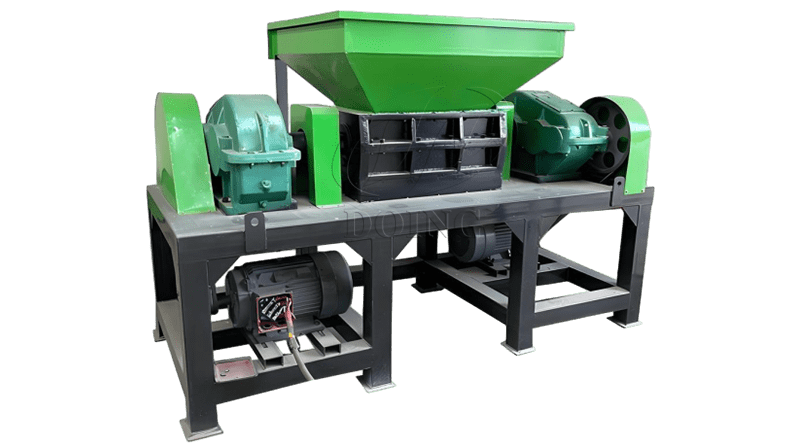
The PKS should first be checked for moisture content and particle size. If the shells are too large or uneven, crushing or screening may be required to achieve a more consistent feed. Uniform feedstock makes continuous feeding and heat transfer easier to control.
Drying
If the incoming PKS contains excessive moisture, a drying system should be installed before carbonization. Drying prevents a large amount of furnace heat from being consumed by water evaporation. DOING ECO can configure a drying stage according to the actual moisture content and processing capacity of the customer's PKS.
The dryer size should not be determined from the 20-ton/day figure alone. For example, 20 tons of relatively dry PKS and 20 tons of high-moisture PKS can require significantly different drying capacities.
Continuous Carbonization
For a steady 20-ton/day feedstock supply, a continuous carbonization furnace is well suited to regular industrial production.
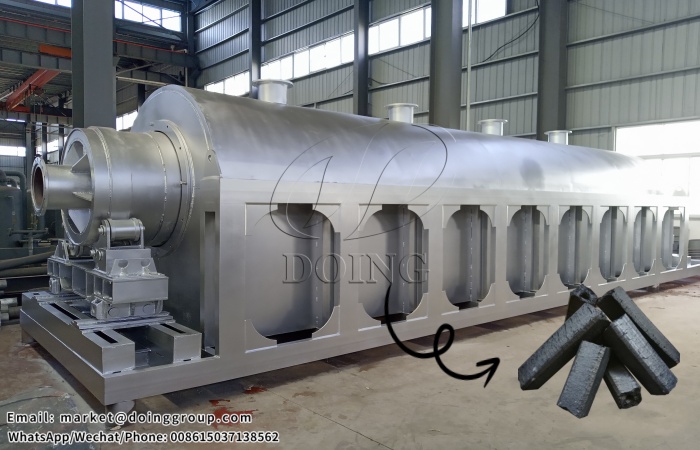 Continuous carbonization furnace
DOING ECO's continuous carbonization equipment uses a double-cylinder structure. The inner cylinder is responsible for material movement and preheating/dehydration, while the outer cylinder provides the heating environment for carbonization. The system can operate at approximately 480–550°C, with the actual operating temperature adjusted according to the feedstock and desired biochar characteristics. The carbonization residence time can reach 50+ minutes, providing sufficient time for the biomass to undergo thermal conversion under controlled conditions.
Temperature and residence time are important because biochar properties change with carbonization conditions. Higher temperatures can generally increase carbonization degree and fixed carbon while reducing biochar yield, so the operating conditions should be selected according to the intended use of the final biochar.
Combustible Gas Utilization
PKS releases combustible gas during carbonization. Rather than treating this gas simply as waste, the DOING ECO system can collect and reuse it as a heat source for the carbonization process. This helps reduce the need for continuous external fuel input once the system reaches stable operation. For a plant processing 20 tons of PKS every day, this heat-reuse approach is particularly useful for maintaining continuous thermal operation.
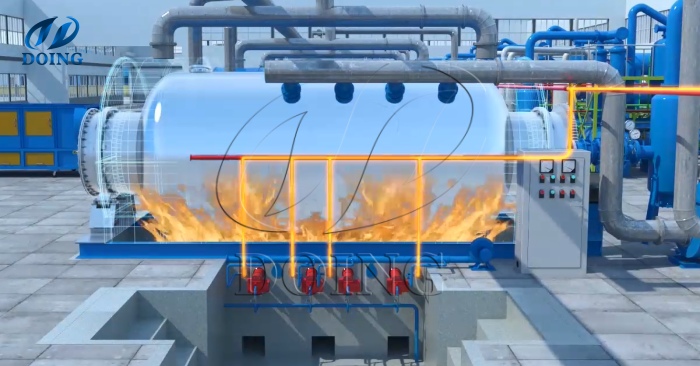 Reused combustible gas heating
Biochar Cooling and Discharge
Freshly carbonized biochar remains at a high temperature and should be cooled under controlled conditions before collection. A dedicated cooling and discharge system allows the biochar to be safely collected while supporting continuous operation. The cooling equipment can be configured together with the continuous carbonization equipment according to the required production capacity.
Processing 20 tons of PKS every day is different from producing biochar occasionally or on a small experimental scale.
A batch furnace requires repeated loading, heating, carbonization, cooling, and unloading. For regular industrial production, these repeated cycles can make production management more complicated.
A system based on continuous carbonization equipment allows the feedstock to enter and the finished biochar to leave the system continuously. This makes it easier to maintain a consistent production schedule and integrate the carbonization process with upstream and downstream equipment. DOING ECO's continuous carbonization equipment has a typical capacity range of approximately 1–5 t/h, with larger customized systems available for higher-capacity projects.
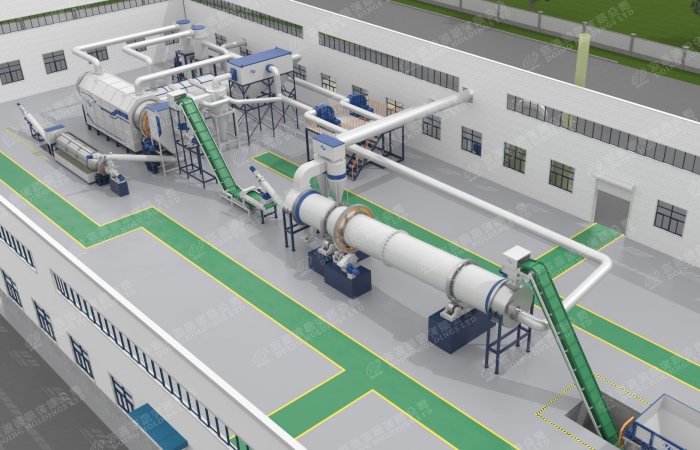 PKS pyrolysis equipment
For PKS biochar production, relevant equipment features include:
Continuous feeding and discharge for regular industrial production
Double-cylinder furnace structure for preheating, drying, and carbonization
Approximately 480–550°C operating temperature, adjustable according to feedstock requirements
50+ minutes of carbonization residence time
Combustible gas reuse to reduce external fuel consumption
PLC control for monitoring and controlling key operating parameters
304 stainless steel and Q345R materials used according to equipment design requirements
Customized integration of drying, carbonization, cooling, and gas utilization
The objective is not simply to choose the largest carbonization furnace. The equipment should be matched to the actual hourly feed rate, feedstock characteristics, operating schedule, and desired biochar properties.
Before ordering palm kernel shell pyrolysis equipment for a 20-ton/day PKS project, several basic parameters should be confirmed.
PKS moisture content:
This determines whether a dryer is required and affects the size of the drying system.
Feedstock particle size:
Particle size and uniformity influence feeding, heat transfer, and carbonization performance.
Daily operating hours:
Twenty tons processed in 16 hours requires a higher hourly capacity than the same amount processed continuously over 24 hours.
Biochar application:
Biochar intended for soil improvement, fuel, carbon sequestration, or further processing may require different carbonization conditions. This is especially important when designing a palm kernel shell biochar production line because the target product properties can affect the operating temperature and residence time.
Project location:
Local environmental and emissions requirements should be considered when designing the heating and exhaust-gas treatment system.
These factors are why a supplier should not select equipment simply from the statement “20 tons of PKS per day.” A project-specific equipment proposal should be based on the actual feedstock and production requirements.
If you are planning to process 20 tons of palm kernel shells per day, you can send DOING ECO your PKS moisture content, particle size, daily operating hours, desired biochar application, and project location. If available, photos or a sample of the PKS can also help with equipment selection.
DOING ECO can then recommend a suitable continuous carbonization capacity and complete equipment configuration based on your actual operating conditions, rather than simply matching your project to a standard furnace. This approach helps determine the right palm kernel shell pyrolysis equipment for your feedstock and production target.
Yes. The required capacity depends on the operating schedule. At 24 hours per day, 20 tons/day corresponds to an average feed rate of about 0.83 t/h. A 1–2 t/h continuous system can provide additional operating flexibility.
Not necessarily. It depends on their incoming moisture content. If the PKS is already sufficiently dry, extensive drying may not be required. If the moisture content is high, a dryer should be considered to reduce heat consumption and improve process stability.
A typical operating range for the DOING ECO continuous carbonization system is approximately 480–550°C. The actual temperature should be adjusted according to the PKS characteristics and the required properties of the biochar.
Yes. The combustible gas generated during carbonization can be collected and reused in the heating system. This can reduce the amount of external fuel required during continuous operation.
The key information includes daily PKS volume, moisture content, particle size, operating hours, desired biochar application, and project location. Photos or samples of the PKS can also help engineers evaluate the feedstock and recommend the appropriate palm kernel shell pyrolysis equipment configuration.

Please provide us with project information as much as possible.



Copyright © 2015-2026 DOING Holdings - Henan Doing Environmental Protection Technology Co., Ltd | Privacy Policy | All Rights Reserved